
Testosterone replacement therapy (TRT) has attracted enormous attention in recent years. While much of the discussion focuses on energy, libido, muscle mass and wellbeing, there is another question that receives considerably less attention:
What does increasing testosterone actually do to your hair and skin?
Both are highly responsive to androgens. The skin, sebaceous glands and hair follicles contain androgen receptors and can also metabolise testosterone locally.
For some men, the changes are barely noticeable. For others, increased oiliness, acne or accelerated hair thinning can become significant concerns.
The effects are not the same for everyone. Genetics, androgen sensitivity, age, baseline hormone levels, dose and the type of testosterone treatment all play a part.
So, what does the evidence actually show?
Does TRT cause hair loss?
Not necessarily – but it may accelerate male-pattern hair loss in men who are genetically susceptible.
Testosterone acts directly through the androgen receptor, but it can also be converted by the enzyme 5-alpha-reductase into dihydrotestosterone (DHT), a more potent androgen.
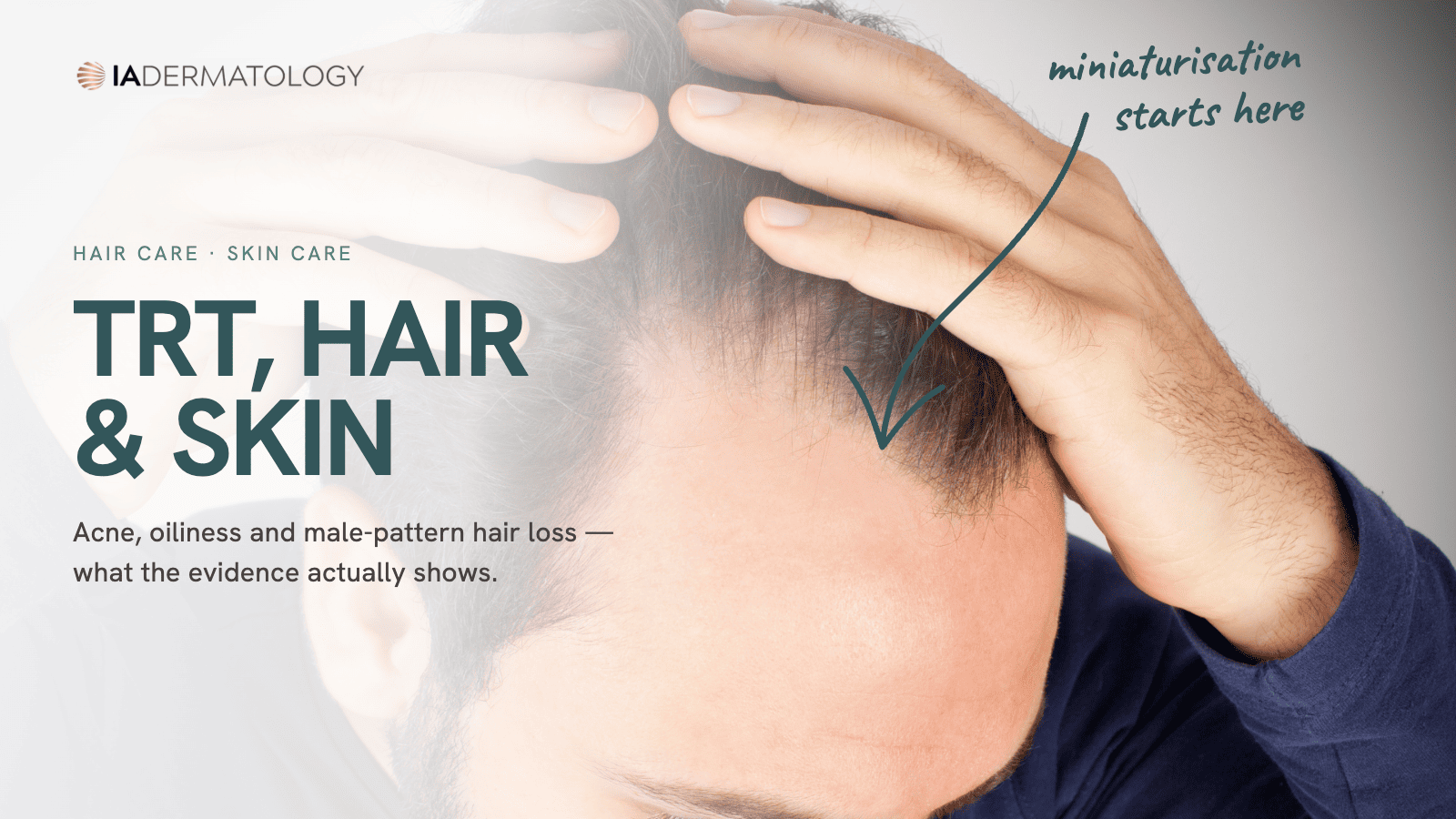
In susceptible scalp follicles, particularly around the temples, frontal hairline and crown.
DHT contributes to a process called follicular miniaturisation.
Over successive hair cycles, affected follicles become smaller and produce progressively shorter and finer hairs. Eventually, some may stop producing visible hair altogether.
This is androgenetic alopecia, commonly known as male-pattern hair loss.
TRT therefore doesn’t simply “cause baldness”. A more accurate way of looking at it is that increasing androgen exposure may accelerate androgenetic alopecia in someone whose follicles are already genetically susceptible.
Indeed, major testosterone-treatment guidelines describe familial male-pattern balding as a possible adverse effect of testosterone therapy, although the evidence directly linking therapeutic TRT to balding remains relatively weak.
A strong family history of early male-pattern hair loss is therefore worth considering before starting treatment.
Why can testosterone increase body hair but reduce scalp hair?
This is one of the interesting paradoxes of testosterone.
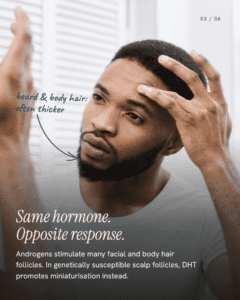
Higher androgen activity can encourage thicker beard and body hair while having exactly the opposite effect on susceptible scalp follicles.
The reason is that hair follicles in different parts of the body respond differently to androgens.
Androgens stimulate many facial and body hair follicles. In genetically susceptible scalp follicles, however, DHT promotes progressive miniaturisation.
So the same hormonal pathway can effectively encourage one follicle to grow while causing another to shrink.
Does TRT cause acne?
This is where the evidence is considerably stronger.
Acne and increased skin oiliness are recognised adverse effects of testosterone replacement therapy.
Sebaceous glands produce sebum, the lipid-rich substance responsible for the skin’s natural oiliness. Androgens stimulate sebaceous gland activity, which is one reason acne commonly appears during puberty as androgen activity increases.
TRT can produce a similar effect.
A 2026 scoping review specifically examining the dermatological effects of TRT found acne to be the most frequently reported skin complication, affecting approximately 0.6–9.1% of men across the studies included.
Other reported effects included itching, rashes and changes in hair growth.
Importantly, these figures are considerably lower than some of the acne rates quoted online, which may be derived from different populations receiving testosterone rather than men receiving physiological testosterone replacement for hypogonadism.
Acne may affect the:
- Face
- Chest
- Shoulders
- Upper back
For most men it is relatively mild, although inflammatory and occasionally nodulocystic acne can occur.
And developing acne does not automatically mean that TRT needs to be stopped.
Conventional acne treatments — including topical retinoids and, where appropriate, oral treatments — can usually be used while testosterone therapy continues.
Does the type of TRT matter?
Possibly.
Different testosterone preparations produce different patterns of testosterone exposure.
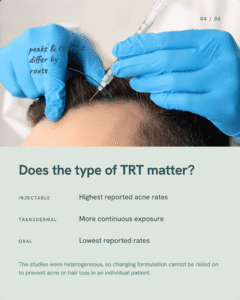
Some injectable preparations can produce greater peaks and troughs in circulating testosterone concentrations, whereas transdermal preparations tend to provide more continuous exposure.
Interestingly, the recent dermatology review found that injectable testosterone preparations generally had higher rates of acne than topical or oral preparations, while oral formulations had the lowest reported rates.
However, the studies were heterogeneous and dermatological side effects were not always systematically assessed. We therefore cannot say that simply changing formulation will prevent acne or hair loss in an individual patient.
The aim of genuine testosterone replacement therapy is generally to restore testosterone to an appropriate physiological range rather than produce supraphysiological concentrations.
If significant skin or hair problems develop, it is reasonable to review the dose, blood levels and formulation with the prescribing clinician rather than treating the skin or hair completely in isolation.
Does testosterone make your skin thicker?
The relationship between testosterone and skin is more complicated than simply causing acne.
Androgen signalling influences several components of skin biology, including sebaceous glands, fibroblasts and the extracellular matrix within the dermis.
Sex hormones also contribute to some of the structural differences between male and female skin, with male skin generally being thicker.
This has led to interest in whether correcting testosterone deficiency might influence dermal structure.
However, this area needs some perspective.
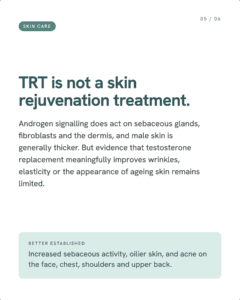
Although there are biological reasons why testosterone could influence dermal thickness and collagen, TRT should not be regarded as a skin rejuvenation or anti-ageing treatment. Evidence that testosterone replacement meaningfully improves wrinkles, elasticity or the cosmetic appearance of ageing skin remains limited.
The much better-established dermatological effects are increased sebaceous activity and the potential for acne.
Can you protect your hair while taking TRT?
Potentially.
If progressive androgenetic alopecia develops while taking testosterone, there are established treatments.
1. Minoxidil
Topical minoxidil can help prolong the hair growth phase and maintain or improve hair density.
Low-dose oral minoxidil is also increasingly used in appropriately selected patients, although its use for hair loss is off-label and requires appropriate medical assessment.
2. Finasteride
Finasteride inhibits 5-alpha-reductase and therefore reduces the conversion of testosterone into DHT.
It is one of the best-established treatments for male-pattern hair loss and can significantly slow progression in many men.
3. Dutasteride
Dutasteride inhibits both type I and type II 5-alpha-reductase and suppresses DHT more strongly than finasteride.
Its regulatory status for androgenetic alopecia differs between countries, and its use needs to be considered individually.
For someone receiving TRT, the decision to use a 5-alpha-reductase inhibitor should ideally be discussed with the clinicians managing both their testosterone treatment and their hair loss.
Should you think about your hair before starting TRT?
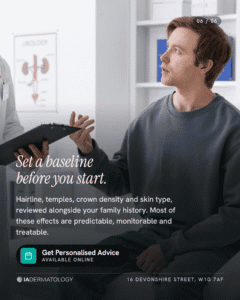
If preserving your hair is important to you, it makes sense to establish a baseline before starting treatment.
Look at:
- Your frontal hairline
- Your temples
- Crown density
- Evidence of existing miniaturisation
- Your family history of male-pattern hair loss
Baseline photographs taken under consistent lighting can be surprisingly useful for identifying gradual changes. Dermoscopic or trichoscopic images are a more objective measure of hair follicle appearance and can be undertaken in a specialist clinic.
The same principle applies to the skin. Someone who already has oily or acne-prone skin may notice increased sebaceous activity after starting testosterone.
Early intervention is generally preferable to waiting until significant acne scarring or advanced hair miniaturisation has occurred.
So, does TRT mean sacrificing your hair and skin?
No.
But it does mean understanding how testosterone affects them.
TRT can increase skin oiliness and trigger acne. It can increase facial and body hair while potentially accelerating male-pattern scalp hair loss in genetically susceptible men.
Individual susceptibility matters enormously.
Some men will experience very little change. Others may notice acne or progressive hair thinning relatively quickly.
The important point is that many of these effects are predictable, monitorable and treatable.
If you already have acne or a strong family history of male-pattern hair loss, it is worth thinking about these issues before starting TRT rather than after the changes have become established.
And if skin or hair problems do develop, they can usually be treated without automatically having to abandon medically indicated testosterone replacement therapy.
References
- Abou Chawareb E, Campos L, Savio L, et al. Dermatological adverse effects of testosterone replacement therapy: a scoping review of the literature. Sexual Medicine Reviews. 2026;14(1).
- Bhasin S, Brito JP, Cunningham GR, et al. Testosterone Therapy in Men With Hypogonadism: An Endocrine Society Clinical Practice Guideline. Journal of Clinical Endocrinology & Metabolism. 2018;103(5):1715–1744.
- Lai JJ, Chang P, Lai KP, Chen L, Chang C. The role of androgen and androgen receptor in skin-related disorders. Archives of Dermatological Research. 2012;304:499–510.
- Zouboulis CC. Acne and sebaceous gland function. Clinics in Dermatology. 2004;22(5):360–366.
- Zouboulis CC, Degitz K. Androgen action on human skin — from basic research to clinical significance. Experimental Dermatology. 2004;13(Suppl 4):5–10.
- Kanti V, Messenger A, Dobos G, et al. Evidence-based (S3) guideline for the treatment of androgenetic alopecia in women and in men. Journal of the European Academy of Dermatology and Venereology. 2018;32(1):11–22.
- Kaiser M, Abdin R, Gaumond SI, Issa NT, Jimenez JJ. Treatment of androgenetic alopecia: current guidance and unmet needs. Clinical, Cosmetic and Investigational Dermatology. 2023;16:1387–1406.
- Piraccini BM, Blume-Peytavi U, Scarci F, et al. Efficacy and safety of topical finasteride spray solution for male androgenetic alopecia: a phase III randomised controlled clinical trial. Journal of the European Academy of Dermatology and Venereology. 2022;36(2):286–294.
This article is intended for general education and does not replace individual medical advice. Testosterone replacement therapy should be prescribed and monitored by an appropriately qualified clinician.
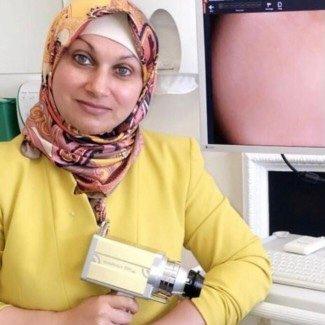
Dr Iaisha Ali, MB ChB MRCP MSc(Oxon)
A London-based dermatologist, specialises in acne, hair loss, hormonal skin disorders, and skin cancer treatment.
Dr Ali has been practising dermatology since 2002, with over 25 years of medical experience delivering consultant-led dermatological care. She previously served as Consultant Dermatologist and Clinical Head of Dermatology at Imperial College Healthcare NHS Trust, where she led complex dermatology services and specialist referral clinics.
