
Many patients report the same observation: at certain times of the year, particularly towards late summer and autumn, there seems to be more hair in the shower, on the brush and around the house.
Is this simply perception, or does human hair actually have a seasonal cycle?
The evidence suggests that seasonal variation in human scalp-hair cycling is real, although it is much more subtle than the dramatic seasonal moulting seen in many other mammals.
Human hair does not grow continuously
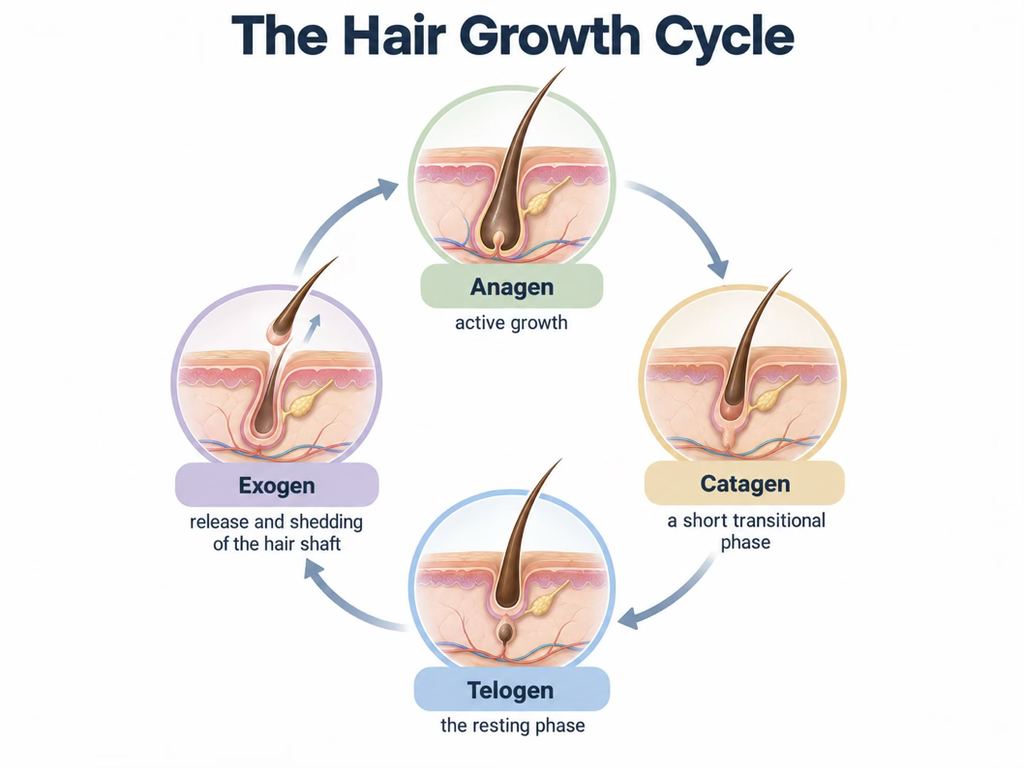
Each scalp follicle repeatedly cycles through several phases. Anagen is the active growth phase and typically lasts several years; at any one time, around 85–90% of scalp hairs are in anagen. This is followed by catagen, a short transitional phase lasting around 2–3 weeks, during which the follicle regresses; only about 1% of hairs are normally in catagen. The follicle then enters telogen, a resting phase lasting roughly 2–3 months, with around 10–15% of scalp hairs in telogen at any one time. Finally, during exogen, the old club hair is released and shed, often as a new anagen hair begins to grow beneath it. These proportions vary between individuals and can shift in response to illness, hormones, medications, nutritional factors and, as the seasonal shedding studies suggest, possibly the time of year.
Unlike many mammals, human scalp follicles are largely asynchronous: neighbouring follicles are generally at different stages of their cycle. This is why humans do not normally undergo a dramatic seasonal moult, but asynchronous does not mean completely random.
Several studies conducted over more than three decades suggest that the proportion of follicles moving through these phases changes subtly during the year.
What does the human evidence show?
One of the best-known studies was published by Randall and Ebling in the British Journal of Dermatology in 1991.
They studied 14 healthy men living in Sheffield in the UK, measuring hair-growth parameters every 28 days for 18 months.
The proportion of scalp follicles in active anagen growth exceeded 90% in March, before gradually declining to its lowest point in September.
Measured hair shedding moved in the opposite direction. The largest number of hairs was shed around August and September, when the proportion of follicles in anagen was lowest. At the peak, average shedding was approximately 60 hairs per day; more than twice that measured during the preceding winter. [1]
A particularly valuable study by Courtois and colleagues subsequently followed 10 men for between 8 and 14 years. Using repeated phototrichograms, they again demonstrated annual periodicity, with the highest proportion of telogen hairs occurring towards the end of summer and beginning of autumn.
Importantly, the pattern was not identical in every individual. Some subjects showed a second annual peak, while those with very low telogen proportions showed little or no periodicity at all. [2]
This suggests that seasonal variation in hair cycling exists at a population level, but its expression differs substantially between individuals.
What about women?
The largest frequently cited study was published by Kunz, Seifert and Trüeb in 2009. They retrospectively analysed trichograms from 823 otherwise healthy women presenting with hair-loss complaints over six years, after excluding recognised medical and drug-related causes.
Again, there was a clear annual pattern; the proportion of hairs in telogen was highest during the summer, with a smaller possible second peak during spring. Telogen rates were lowest in late winter. [3]
Because movement through the hair cycle occurs over weeks to months rather than days, a summer shift towards telogen may contribute to increased shedding later in the summer and into autumn.
The pattern is not confined to European populations
In 2014, Liu and colleagues followed 41 healthy Chinese volunteers across a full year using phototrichographic assessment. They demonstrated seasonal variation in scalp-hair cycling, with the highest proportion of telogen hairs occurring around September and the lowest around January. [4]
This provides useful evidence that the phenomenon is not confined to European cohorts, an important distinction.
Seasonal cycling does not necessarily indicate disease. It may simply represent physiological variation within the normal human hair cycle.
Population data point in the same direction
A very different approach was taken by Hsiang and colleagues.
They analysed Google Trends search activity relating to hair loss between 2004 and 2016 and demonstrated a reproducible seasonal pattern in population-level interest in hair loss. [5] This is supportive rather than direct biological evidence.
Search behaviour cannot establish changes in follicular cycling or prove a mechanism. However, the seasonal pattern in public search activity is broadly consistent with the periodicity described in direct studies of human hair growth and shedding.
So how strong is the evidence?
It is useful to separate the different levels of evidence.
The strongest evidence comes from studies that directly examined human hair cycling using hair counts, trichograms or phototrichograms.
Across these studies, the same broad pattern repeatedly emerges; relatively greater anagen activity during late winter or spring, increasing telogen proportions during summer, increased shedding towards late summer and autumn, substantial variation between individuals.
The Google Trends data are interesting because they mirror that pattern at population level, but they should be regarded as corroborative rather than proof of biological seasonality.
So the existence of some degree of seasonal variation in human scalp hair cycling is reasonably well supported.
The next question is much harder; why does it happen?
Why might hair growth vary with the seasons?
This is where the evidence becomes much less certain. We have substantially better evidence that seasonal variation exists than we have explaining why it exists.
Photoperiod may be important
In many mammals, seasonal coat growth is controlled primarily by photoperiod. The changing duration of daylight, rather than simply by temperature.
Changes in day length are detected through the retina and translated into neuroendocrine signals capable of altering follicular activity. Humans retain many of these seasonal biological pathways, making photoperiod an attractive explanation for the subtle seasonal rhythm seen in scalp hair.
There are also clues within the human studies themselves.The long-term Courtois study discussed relationships between hair-cycle periodicity and environmental factors including hours of sunshine, while later studies have considered latitude and daylight duration as possible contributors to variation between populations. [2,4]
Association, however, does not prove causation.
What about melatonin?
Melatonin is one of the major hormones through which mammals translate changes in light exposure into seasonal biological signals. It is secreted predominantly during darkness, so both the timing and duration of melatonin secretion vary with day length.
Experimental studies in animals show that manipulating photoperiod or melatonin signalling can alter seasonal coat growth. Human hair follicles also appear capable of responding to melatonin.
In a small randomised placebo-controlled pilot study, Fischer and colleagues found that topical melatonin increased the proportion of hairs in anagen in women with androgenetic or diffuse alopecia. [6]
This tells us that melatonin can influence the human hair follicle. It does not, however, prove that naturally occurring seasonal changes in melatonin are responsible for seasonal human hair shedding. That distinction is important.
Could other hormones contribute?
Seasonal rhythms have also been described in several human hormones, including testosterone and prolactin. Both are biologically relevant to the hair follicle, and prolactin in particular has recognised effects on follicular and keratinocyte biology.
However, the evidence linking these hormones specifically to seasonal scalp shedding remains largely indirect and correlational. No study has convincingly demonstrated that seasonal fluctuations in testosterone, prolactin or melatonin independently produce the seasonal scalp-hair cycle seen in humans.
The most reasonable interpretation at present is therefore that seasonal shedding may reflect a complex interaction between photoperiod, neuroendocrine signalling and intrinsic follicular biology, rather than a single hormone switching the hair cycle on or off.
Are humans really “moulting”?
Not in the way many mammals do.
Animals with obvious seasonal coats can synchronise very large numbers of follicles, producing dramatic shedding over a short period. Human scalp follicles remain predominantly asynchronous.
What appears to persist is a much weaker biological rhythm: enough to alter the percentage of follicles in anagen and telogen at different times of year, but generally not enough to produce dramatic loss of scalp coverage.
Seasonal shedding may therefore represent a subtle residual expression of a mammalian biological system that is much more prominent in other species.
Seasonal shedding is not the same as telogen effluvium
This is probably the most important clinical distinction.
A modest seasonal increase in shedding can occur as part of normal physiology. Telogen effluvium, however, describes a larger disruption of the follicular cycle and can follow significant illness or fever, surgery, childbirth, rapid weight loss, nutritional deficiency, thyroid disease, major physiological stress, hormonal change and certain medications.
The timing may overlap; someone who develops telogen effluvium in the autumn may understandably assume that the season is responsible when another trigger actually occurred several months earlier.
Seasonal shedding may also reveal underlying pattern hair loss
Another scenario I see clinically is a patient who notices considerably more scalp visibility during a period of increased shedding.
They may already have subtle female or male pattern hair loss. A temporary increase in shedding reduces the amount of remaining hair coverage and makes that underlying reduction in density much more apparent.
The seasonal shed has not necessarily caused androgenetic alopecia -It may simply have unmasked it.
For that reason, persistent widening of the parting, temporal recession, progressive miniaturisation or continuing reduction in hair volume should not automatically be attributed to autumn.
When should seasonal shedding be investigated?
A temporary increase in shedding with preserved overall density can be physiological.
Further assessment is more important when shedding is:
- Marked or sudden
- Continuing for several months
- Accompanied by progressive thinning
- Associated with widening of the central parting
- Associated with scalp inflammation, scaling or symptoms
- Accompanied by eyebrow or body-hair loss
- Associated with systemic symptoms
- Preceded by illness, major weight change, dietary restriction or medication change
The fact that hair shedding begins in autumn should not prevent us from looking for another cause.
So, is seasonal hair shedding real?
The available human evidence says yes.
Studies using hair counts, trichograms and phototrichograms — including longitudinal observations lasting more than a decade — demonstrate a reproducible annual rhythm in human scalp-hair cycling.
Broadly, the proportion of telogen hairs tends to rise during summer and early autumn, while anagen activity tends to be greater during late winter and spring. But the size of this effect varies between individuals, and in healthy people it usually appears to represent physiological variation rather than disease.
The mechanism remains considerably less certain. Photoperiod and melatonin provide a biologically plausible explanation, supported by mammalian biology and evidence that human follicles can respond to melatonin, but they have not been proven to be the cause of seasonal human shedding.
So when a patient tells me:
“My hair always sheds more at this time of year,”
I do not automatically dismiss the observation.
There may indeed be a biological explanation.
The more important clinical question is whether we are seeing a normal seasonal fluctuation in hair cycling or whether another cause of increased shedding or progressive hair loss is occurring alongside it.
References
- Randall VA, Ebling FJ. Seasonal changes in human hair growth. Br J Dermatol. 1991;124(2):146–151. doi:10.1111/j.1365-2133.1991.tb00423.x.
- Courtois M, Loussouarn G, Hourseau C, Grollier JF. Periodicity in the growth and shedding of hair. Br J Dermatol. 1996;134(1):47–54.
- Kunz M, Seifert B, Trüeb RM. Seasonality of hair shedding in healthy women complaining of hair loss. Dermatology. 2009;219(2):105–110. doi:10.1159/000216832.
- Liu C, et al. Changes in Chinese hair growth along a full year. Int J Cosmet Sci. 2014;36(6):531–536.
- Hsiang EY, Kwatra SG, Pasquali L, Ganta S, Burnett C, Liao Y. Seasonality of hair loss: a time series analysis of Google Trends data 2004 to 2016. Br J Dermatol. 2017;177(3):953–954. doi:10.1111/bjd.16075.
- Fischer TW, Burmeister G, Schmidt HW, Elsner P. Melatonin increases anagen hair rate in women with androgenetic alopecia or diffuse alopecia: results of a pilot randomized controlled trial. Br J Dermatol. 2004;150(2):341–345.
Dr Iaisha Ali, MB ChB MRCP MSc(Oxon)
A London-based dermatologist, specialises in acne, hair loss, hormonal skin disorders, and skin cancer treatment.
Dr Ali has been practising dermatology since 2002, with over 25 years of medical experience delivering consultant-led dermatological care. She previously served as Consultant Dermatologist and Clinical Head of Dermatology at Imperial College Healthcare NHS Trust, where she led complex dermatology services and specialist referral clinics.
