
From unexpected regrowth to licensed targeted therapy
What changed
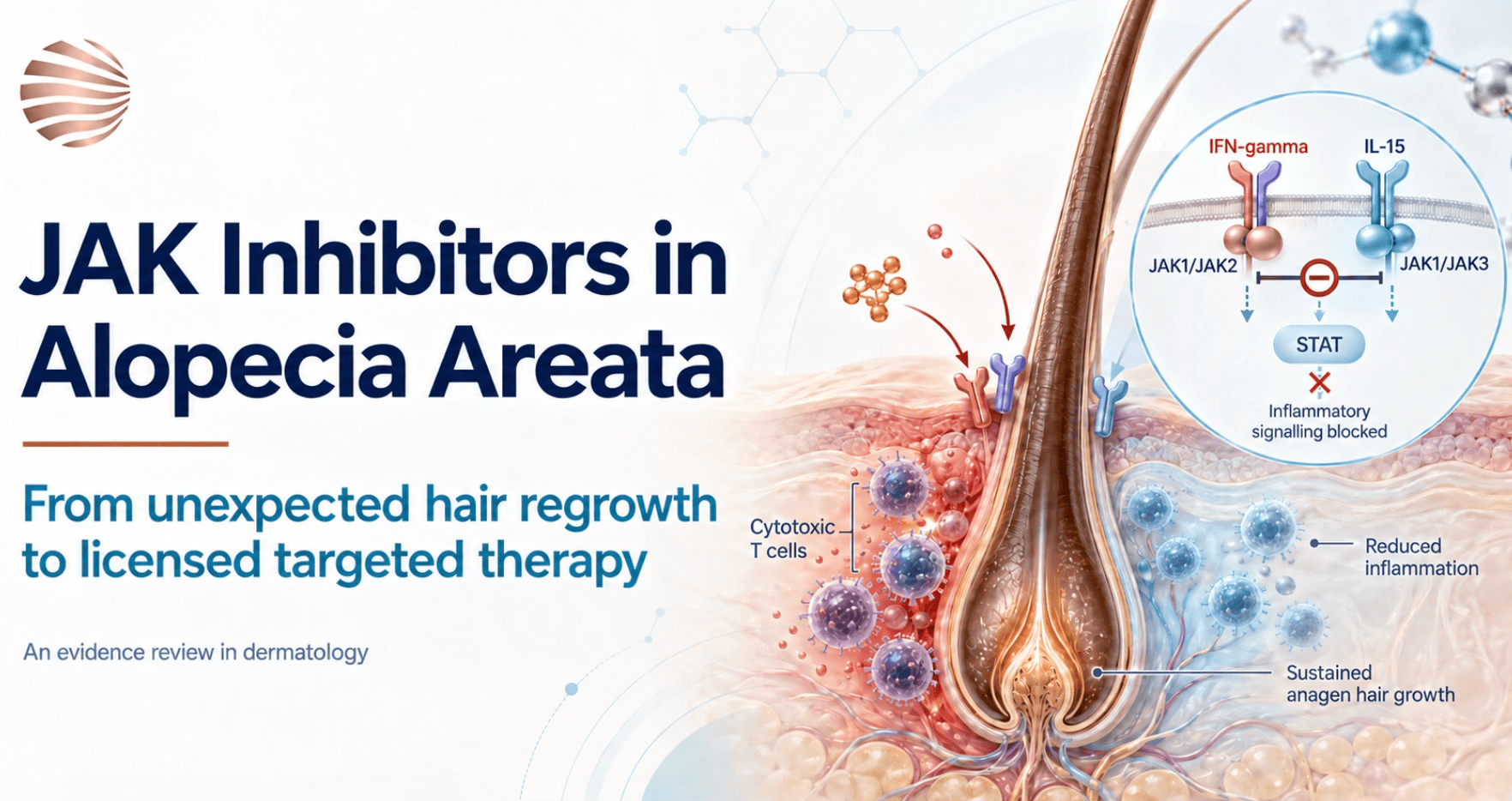
Alopecia areata has moved from an era of broad immunosuppression to one of targeted oral therapy. The turning point came in 2014, when hair regrowth was reported with two drugs developed for other inflammatory diseases: tofacitinib and ruxolitinib. These clinical observations were supported by laboratory studies in human scalp tissue and mouse models. Researchers identified a self-sustaining inflammatory loop in which cytotoxic T cells attack the hair follicle through cytokines including interferon gamma and interleukin-15. Because these cytokines transmit their signals through the JAK-STAT pathway, blocking JAK activity reduced follicular inflammation and allowed hair growth to resume. This evidence led to formal drug-development programmes. Three oral JAK-pathway inhibitors are now licensed for severe alopecia areata in the United Kingdom: baricitinib, ritlecitinib and, since March 2026, deuruxolitinib. Only ritlecitinib is currently recommended by NICE for routine NHS use; the NICE appraisal of deuruxolitinib is still in progress, while baricitinib was not recommended on cost-effectiveness grounds.
This is an important therapeutic advance, but it is not a cure. Responses are variable, improvement may continue beyond the primary trial endpoint, and relapse is common after treatment withdrawal. Comparisons between drugs must also be cautious: there are no definitive head-to-head trials, and pivotal studies differ in age range, baseline severity, duration, dosing and endpoint timing.
Why blocking JAK signalling can restore hair growth
In alopecia areata, cytotoxic T cells cluster around anagen hair follicles and disrupt their immune privilege. Interferon gamma signalling uses JAK1 and JAK2, while interleukin 2, interleukin 7 and interleukin 15 signal through JAK1 and JAK3. Blocking these pathways can interrupt the inflammatory loop and allow a viable, non-scarring follicle to re-enter anagen. This biological rationale explains why inhibitors with different kinase selectivity can all produce regrowth, although selectivity may affect dose, safety and the balance of clinical activity.
The chronology of clinical discovery
| First AA signal | Drug or programme | What was reported |
|---|---|---|
| 2014 | Tofacitinib | A patient treated for psoriasis and alopecia universalis developed substantial scalp, eyebrow and eyelash regrowth. Further case series and open-label studies followed. Tofacitinib inhibits JAK1 and JAK3, with broader activity at clinical concentrations. |
| 2014 | Ruxolitinib | Mechanistic work in a mouse model was accompanied by near-complete regrowth in three patients treated orally. Ruxolitinib inhibits JAK1 and JAK2. A later open-label study supported oral efficacy, but a vehicle-controlled trial of topical ruxolitinib cream did not show a significant benefit. |
| 2015 | Baricitinib | Regrowth was reported in a patient receiving baricitinib for CANDLE syndrome. This JAK1 and JAK2 inhibitor subsequently became the first drug licensed specifically for severe alopecia areata, following the BRAVE-AA programme. |
| 2018 to 2021 | Ritlecitinib and brepocitinib | Randomised development programmes tested greater kinase selectivity. Ritlecitinib irreversibly inhibits JAK3 and the TEC kinase family; brepocitinib inhibits TYK2 and JAK1. Both improved SALT outcomes in a phase 2a trial, but only ritlecitinib progressed to licensing for alopecia areata. |
| 2020 to 2024 | Deuruxolitinib | Originally called CTP-543, this is a deuterated form of ruxolitinib designed to alter metabolism and exposure. Phase 2 and THRIVE phase 3 trials established efficacy. It was licensed in the United States in July 2024 and in the United Kingdom in March 2026. |
| 2021 onward | Ivarmacitinib and jaktinib | Selective JAK1 programmes produced positive randomised data, particularly in China. Ivarmacitinib phase 3 results showed substantial week-24 responses, but neither drug is licensed for alopecia areata in the UK. |
| 2022 onward | Upadacitinib and abrocitinib | Hair regrowth was first described in patients treated off-label, often where alopecia areata coexisted with atopic dermatitis. In 2026, two phase 3 UP-AA trials reported strong week-24 efficacy for upadacitinib. It remains unlicensed for alopecia areata at the time of writing. |
The three licensed treatments
The Severity of Alopecia Tool, or SALT, records the percentage of scalp affected by hair loss on a scale from 0 to 100. A final SALT score of 20 or less means no more than 20 percent scalp hair loss, or at least 80 percent scalp coverage, and became the principal endpoint in the licensing trials. This is different from SALT50, SALT75 or SALT90, which describe a 50, 75 or 90 percent relative improvement from an individual patient’s baseline. These endpoints should not be treated as interchangeable.
| Drug | Target | Population | Licensed dose | Endpoint | SALT 20 active | SALT 20 placebo | UK position |
|---|---|---|---|---|---|---|---|
| Baricitinib | JAK1 and JAK2 | Adults with severe AA | 4 mg once daily | Week 36 | 38.8% and 35.9% | 6.2% and 3.3% | UK licensed; not NICE recommended |
| Ritlecitinib | JAK3 and TEC family | Age 12 years and over | 50 mg once daily | Week 24 | 23% | 2% | UK licensed; NICE recommended |
| Deuruxolitinib | JAK1 and JAK2 | Adults with severe AA | 8 mg twice daily | Week 24 | 29.6% and 33.0% | 0.8% and 0.8% | UK licensed March 2026; NICE appraisal pending |
How should relative efficacy be interpreted
At first glance, baricitinib 4 mg appears to produce a higher SALT 20 rate than ritlecitinib 50 mg. That comparison is misleading unless time is considered: baricitinib was assessed at 36 weeks, whereas the pivotal ritlecitinib endpoint was 24 weeks. Ritlecitinib responses continued to accumulate through week 48. Deuruxolitinib produced approximately 30 to 33 percent SALT 20 responses at week 24 with the licensed 8 mg twice-daily dose. Its 12 mg twice-daily trial dose produced higher response rates, but this is not the licensed US dose and should not be used to overstate comparative efficacy.
Longer follow-up changes the clinical picture. With ritlecitinib 50 mg daily, approximately 43 percent of participants reached SALT 20 by week 48, compared with 23 percent at week 24. Most week-24 responders maintained their response, while up to one-third of patients who had not yet reached the target at week 24 did so with continued treatment. In the open-label ALLEGRO-LT cohort, responses continued to increase over 24 months. Those open-label results are encouraging but are affected by continued-treatment selection and attrition and cannot be compared directly with placebo-controlled response rates. UK prescribing guidance advises considering discontinuation if there is no therapeutic benefit after 36 weeks.
Indirect and network meta-analyses generally place higher-dose oral regimens above lower-dose regimens and topical preparations, but rankings depend on which endpoint and time point are selected. They cannot establish that one licensed drug is clinically superior for an individual patient. Age, disease duration, alopecia totalis or universalis, eyebrow and eyelash loss, prior treatment, comorbidity, risk factors, dosing preference and access all influence treatment choice.
The emerging group
Upadacitinib
Upadacitinib is a preferential JAK1 inhibitor already licensed for several inflammatory diseases. Early AA evidence came from case reports and small series. The two phase 3 UP-AA trials, published in 2026, moved it into a different evidence category: at week 24, SALT 20 was achieved by 44.6 to 45.2 percent with 15 mg daily and 54.3 to 55.0 percent with 30 mg daily, compared with 1.5 to 3.4 percent with placebo. These are among the strongest short-term phase 3 results reported in AA, but upadacitinib is not yet licensed for this indication. Cross-trial superiority should not be claimed.
Ivarmacitinib and jaktinib
Ivarmacitinib, a selective JAK1 inhibitor, achieved SALT 20 at week 24 in 34.9 percent of participants receiving 4 mg and 40.6 percent receiving 8 mg, versus 9.0 percent with placebo in a phase 3 trial. Jaktinib has also entered randomised and extension studies. These programmes reinforce JAK1 as an effective target, but neither medicine has a UK alopecia areata licence.
Brepocitinib
Brepocitinib inhibits TYK2 and JAK1. In the early phase 2a comparison it produced a larger mean reduction in SALT than ritlecitinib, but the study was small and used investigational regimens. It has not become a licensed AA treatment. It remains scientifically important because it demonstrated that multiple nodes within the cytokine network can be therapeutically relevant.
Tofacitinib ruxolitinib and abrocitinib
Oral tofacitinib and ruxolitinib were the proof-of-concept drugs. Their evidence includes case reports, series and open-label studies, but neither is licensed for AA. Abrocitinib has produced regrowth in case reports and small real-world cohorts, particularly in patients with concomitant atopic dermatitis, but robust AA-specific randomised evidence remains limited. These observations should not be presented as equivalent to phase 3 evidence.
The early quantitative results nevertheless helped establish that the initial dramatic cases were reproducible. In a 2016 open-label study of 66 patients receiving tofacitinib, 32 percent achieved at least a 50 percent improvement in SALT. Patch-type AA and ophiasis responded better than alopecia totalis or universalis; shorter disease duration and persisting peribulbar inflammation were associated with response. Relapse after stopping treatment occurred after a median of approximately 8.5 weeks. In a separate oral ruxolitinib pilot, nine of 12 patients achieved substantial regrowth, accompanied by suppression of interferon and cytotoxic T-cell gene signatures.
Oral and topical JAK inhibition are not equivalent
The strongest evidence is for systemic oral treatment in severe disease. Topical tofacitinib and ruxolitinib have produced occasional local responses, especially in eyebrows or limited patches, but controlled studies have been inconsistent. In a phase 2 vehicle-controlled study, ruxolitinib cream did not significantly improve the main hair-regrowth endpoint. Poor penetration to the deeper follicular bulb and the difficulty of treating extensive scalp disease may help explain the difference. A topical formulation should therefore not be assumed to reproduce the efficacy of its oral counterpart.
Safety and duration of treatment
All systemic JAK inhibitors require careful patient selection and monitoring. Product-specific guidance differs, but considerations include serious and opportunistic infection, herpes zoster, cytopenias, liver enzyme and lipid abnormalities, creatine kinase elevation, thromboembolic and cardiovascular risk, malignancy risk, vaccination status, pregnancy and drug interactions. Regulatory class warnings were shaped substantially by safety data in older rheumatoid arthritis populations with cardiovascular risk factors; the absolute risk in a younger AA population may differ, but it should not be dismissed.
Deuruxolitinib has an additional pharmacokinetic consideration. It is metabolised predominantly by CYP2C9, with a smaller contribution from CYP3A4, and CYP2C9 poor metabolisers may have approximately twice the systemic exposure. Genotype, interacting medicines and the current territory-specific product information therefore require particular attention.
Treatment duration is equally important. Hair regrowth is often gradual, and some patients who have not reached SALT 20 by week 24 respond later. Conversely, withdrawal studies show that many responders lose hair after stopping treatment and may not recapture the same response immediately when treatment restarts. In practice, successful JAK inhibition is better understood as disease control requiring ongoing review rather than a finite curative course.
Baricitinib provides the clearest long-term evidence. Among week-52 responders who continued therapy, approximately 89 percent receiving 4 mg and 84 percent receiving 2 mg maintained SALT 20 through three years. In the randomized BRAVE-AA1 withdrawal substudy, stopping baricitinib led to loss of treatment benefit in almost all responders, while many regained response after retreatment. These findings support maintenance treatment when benefit continues and the risk-benefit balance remains favourable.
Who is more likely to respond
Response is not determined by drug choice alone. Across trials and observational studies, patients with SALT scores approaching 100, alopecia totalis or universalis, and a longer current episode generally respond more slowly and less completely. Evidence of persisting inflammatory activity and shorter disease duration have been associated with better responses in early tofacitinib studies. These are probabilities rather than absolute rules: clinically meaningful regrowth can still occur in longstanding or near-total disease, but expectations, assessment intervals and stopping decisions should reflect the lower average response rate.
Conclusion
The history of JAK inhibition in alopecia areata began with unexpected regrowth from repurposed drugs and has matured into a class of licensed, evidence-based treatments. Tofacitinib and ruxolitinib established the concept; baricitinib delivered the first licence; ritlecitinib extended licensed treatment to adolescents; and deuruxolitinib added a third UK option in 2026. Upadacitinib now has compelling phase 3 results, while ivarmacitinib, jaktinib, brepocitinib and other selective agents broaden the pipeline. The central message is not that all JAK inhibitors are interchangeable, but that pathway selection, dose, exposure, patient characteristics and treatment duration all matter. The next phase will require direct comparative evidence, longer safety follow-up and better predictors of who will respond and maintain regrowth.
Key references
- Xing et al. Alopecia areata is driven by cytotoxic T lymphocytes and is reversed by JAK inhibition. Nature Medicine. 2014. Link
- Craiglow and King. Tofacitinib treatment of alopecia universalis. Journal of Investigative Dermatology. 2014. Link
- Jabbari et al. Treatment of an alopecia areata patient with tofacitinib results in regrowth of hair and changes in biomarkers. Journal of Investigative Dermatology. 2014. Link
- Jabbari et al. Reversal of alopecia areata following treatment with baricitinib. EBioMedicine. 2015. Link
- Mackay-Wiggan et al. Oral ruxolitinib induces hair regrowth in moderate-to-severe alopecia areata. JCI Insight. 2016. Link
- King et al. Phase 2a study of ritlecitinib and brepocitinib. Journal of the American Academy of Dermatology. 2021. Link
- King et al. Two phase 3 trials of baricitinib for alopecia areata. New England Journal of Medicine. 2022. Link
- King et al. Ritlecitinib phase 2b and 3 trial. The Lancet. 2023. Link
- King et al. Deuruxolitinib THRIVE-AA1 phase 3 trial. Journal of the American Academy of Dermatology. 2024. Link
- THRIVE-AA2 phase 3 trial of deuruxolitinib. Journal of the American Academy of Dermatology. 2025. Link
- Ivarmacitinib phase 3 trial in severe alopecia areata. Journal of the American Academy of Dermatology. 2025. Link
- Mostaghimi et al. Upadacitinib for severe alopecia areata in two phase 3 UP-AA trials. JAMA Dermatology. 2026. Link
- Crispin et al. Safety and efficacy of tofacitinib citrate in patients with alopecia areata. JCI Insight. 2016. Link
- King et al. Baricitinib withdrawal and retreatment in severe alopecia areata. JAMA Dermatology. 2024. Link
- Piliang et al. Sustained and late responses to ritlecitinib through week 48. Journal of the American Academy of Dermatology. 2025. Link
- Tziotzios et al. Long-term safety and efficacy of ritlecitinib in ALLEGRO-LT. Journal of the European Academy of Dermatology and Venereology. 2025. Link
- US Food and Drug Administration. Leqselvi prescribing information. 2024. Link
- MHRA approval of ritlecitinib for severe alopecia areata. 2023. Link
- NICE TA958. Ritlecitinib for treating severe alopecia areata in people aged 12 years and over. 2024. Link
- MHRA approval of deuruxolitinib for severe alopecia areata in adults. 2026. Link
Dr Iaisha Ali, MB ChB MRCP MSc(Oxon)
A London-based dermatologist, specialises in acne, hair loss, hormonal skin disorders, and skin cancer treatment.
Dr Ali has been practising dermatology since 2002, with over 25 years of medical experience delivering consultant-led dermatological care. She previously served as Consultant Dermatologist and Clinical Head of Dermatology at Imperial College Healthcare NHS Trust, where she led complex dermatology services and specialist referral clinics.
