
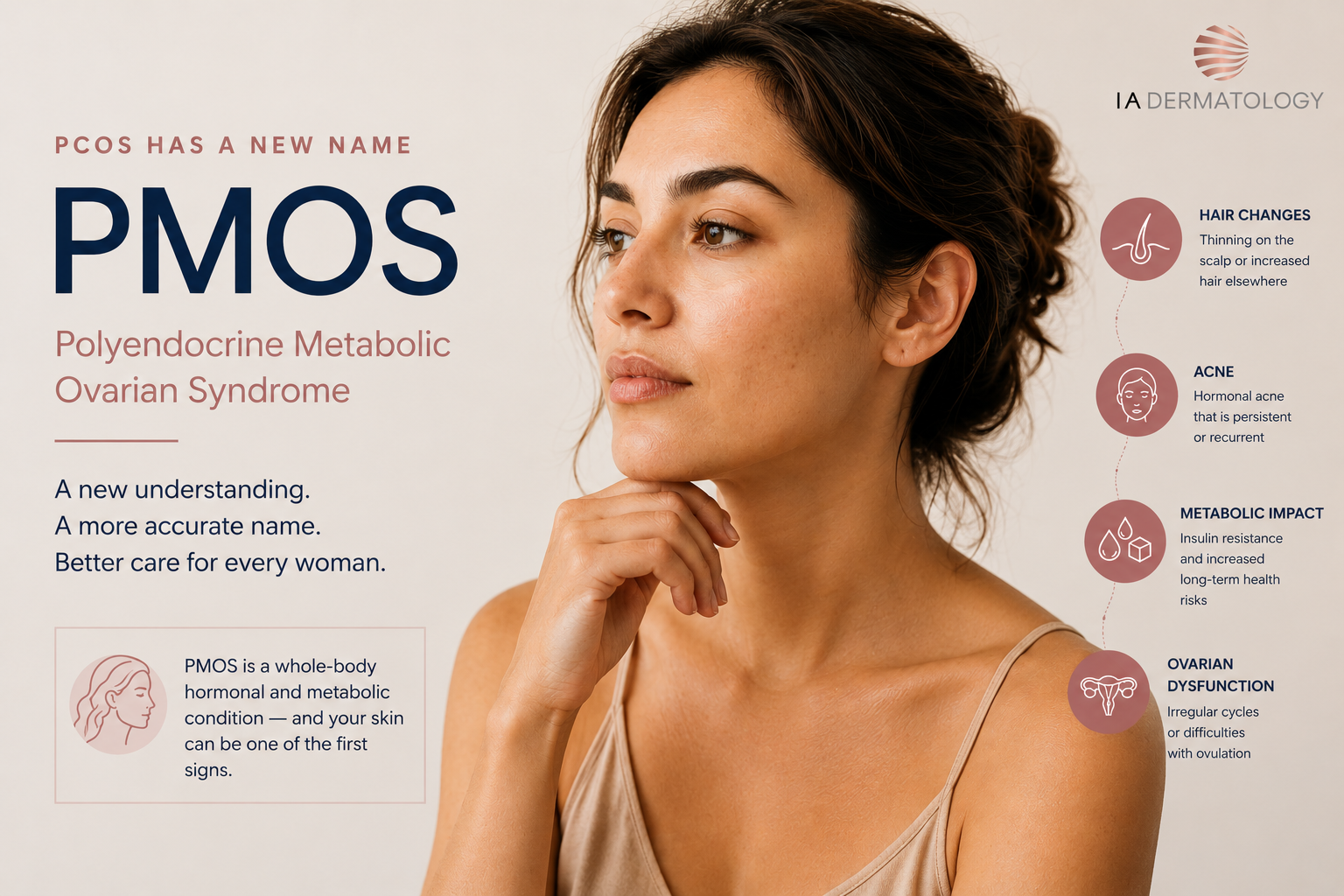
What the landmark reclassification of PCOS to PMOS means for you, and how your dermatology team plays a central role in your care
A Landmark Change in Women’s Health
In May 2026, one of the most significant moments in women’s health in decades took place. A landmark paper published in The Lancet — the world’s most respected medical journal — officially renamed Polycystic Ovary Syndrome (PCOS) to Polyendocrine Metabolic Ovarian Syndrome (PMOS). This change was the result of a 14-year global effort led by Professor Helena Teede of Monash University, involving 56 professional societies, thousands of patients, and healthcare professionals from every corner of the world.
If you have been diagnosed with PCOS — or suspect you might have it — this news matters for you. It does not change your diagnosis. It does not change the treatments that work. What it does change is the way medicine understands, names, and ultimately treats this condition. And that, for millions of women who have spent years feeling dismissed or misunderstood, is profound.
Why Was the Name Wrong in the First Place?
The name ‘Polycystic Ovary Syndrome’ told an incomplete — and in some ways misleading — story. It implied the condition was defined by cysts on the ovaries. In reality, those are not true pathological cysts at all. What shows up on an ultrasound are small, immature follicles that failed to develop properly. Calling them ‘cysts’ pointed doctors and patients toward the ovaries as the source of the problem, when the condition is far more complex than that.
The old name caused real harm:
- Women were often told their main issue was fertility or weight — and little else
- Diagnosis was frequently delayed by years, especially in women without obvious ovarian cysts
- Symptoms affecting the skin — acne, excess hair, hair thinning — were treated as cosmetic nuisances rather than clinical signs
- The metabolic risks — including diabetes, cardiovascular disease, and insulin resistance — were routinely overlooked
- Research funding and policy support lagged behind because the condition was framed too narrowly
Over 14,000 patients and professionals contributed to developing the new name, reporting that the old terminology contributed to stigma, delayed care, and a persistent sense of not being taken seriously.
What Does PMOS Actually Mean?
The new name — Polyendocrine Metabolic Ovarian Syndrome — is more than a rebrand. Each word was chosen with care:
| Poly | Affecting multiple body systems — not just the ovaries |
| Endocrine | A hormone disorder — driven by excess androgens (male-type hormones) and disrupted signalling across multiple glands |
| Metabolic | Insulin resistance and metabolic disturbance are central features — even in women who are not overweight |
| Ovarian | The ovaries are involved — but they are one part of a larger picture, not the whole story |
| Syndrome | A collection of features that present differently in different women — there is no single PMOS |
How Is PMOS Diagnosed?
The diagnostic criteria have not changed. You receive a PMOS diagnosis if you meet at least two of the following three features:
- Irregular or absent menstrual cycles — a sign that ovulation is not happening regularly
- Clinical or biochemical signs of elevated androgens — including acne, excess facial or body hair, or scalp hair thinning, or raised testosterone on a blood test
- Polycystic ovarian morphology on ultrasound — the appearance of multiple small follicles on the ovaries
Crucially, two of the three diagnostic criteria are visible on the skin. Acne, hirsutism, and hair thinning are not side effects or cosmetic complaints — they are recognised diagnostic features of PMOS.
Your Skin as a Window Into Your Hormones
The connection between PMOS and the skin runs deep, and it begins with one molecule: insulin. In PMOS, cells throughout the body become less sensitive to insulin — a state called insulin resistance. The body responds by producing more insulin to compensate. That excess insulin signals the ovaries (and often the adrenal glands) to produce more androgens — male-type hormones such as testosterone. Those androgens then act on the skin in three important ways.
Hormonal Acne
Androgens stimulate the oil glands in the skin to produce more sebum. This creates the environment in which acne-causing bacteria thrive. PMOS-related acne is typically hormonal in pattern — it tends to appear along the jawline, chin, lower cheeks, neck, chest, and back. It is often deeper and more persistent than teenage acne, can be cystic, and frequently returns despite standard skincare or antibiotic treatments. Left untreated, it can cause scarring and significant emotional distress.
Hirsutism — Unwanted Hair Growth
Androgens stimulate hair follicles in certain areas of the body to grow coarser, darker, terminal-type hair in a typically male distribution — upper lip, chin, sideburns, jawline, chest, abdomen, and inner thighs. This is called hirsutism, and it affects up to 70% of women with PMOS. It is one of the features that most significantly affects quality of life, self-confidence, and mental wellbeing. At our London clinic, we find that Nd:YAG Laser treatment is the gold standard for removing this hair safely and permanently, especially when combined with medical hormone management.
Androgenic Alopecia — Hormonal Hair Loss
The same androgens that drive unwanted hair growth elsewhere can also cause hair to thin on the scalp — particularly at the crown and top of the head, following a pattern similar to female pattern hair loss. This occurs because scalp follicles in susceptible women are sensitive to a potent form of testosterone called DHT. Hair thinning is often a deeply distressing symptom, and one that is frequently attributed to stress or ageing when in fact its root cause is hormonal.
Why Dermatology Is Central to Your PMOS Care
For many women, a dermatology appointment is where the PMOS journey begins. Persistent adult acne, hair loss, or distressing facial hair often bring women to a skin clinic long before anyone connects these symptoms to a hormonal condition. The reclassification of PCOS to PMOS formally acknowledges what dermatologists have long understood: the skin is not just collateral damage in this condition — it is a primary site of disease expression and a vital window into what is happening hormonally and metabolically.
A dermatologist who understands PMOS does not simply treat the surface. They treat the whole picture — addressing skin and hair symptoms with targeted interventions while also considering the metabolic drivers that underlie them. This is the approach we take at our clinic.
How We Support Women with PMOS at Our Clinic
Treating Hormonal Acne
Standard over-the-counter products and short courses of antibiotics rarely resolve PMOS-related acne because they do not address its hormonal cause. Our approach is to treat both the skin and the hormone driving it. We use prescription topical treatments including retinoids and azelaic acid, combined where appropriate with anti-androgen therapies to reduce the hormonal stimulus at source. For suitable patients, oral isotretinoin remains an effective option for severe or scarring acne. We also address post-inflammatory pigmentation, which can be particularly pronounced in women with darker skin tones.
Managing Hormonal Hair Loss
Hair loss associated with PMOS is treatable, and — importantly — early intervention leads to better outcomes. We assess the pattern and cause of your hair thinning carefully and offer treatments that work at the follicular level to reduce androgen sensitivity and support regrowth. Alongside topical and oral treatments, we support patients in understanding how hormonal and metabolic treatment can also help slow hair loss over time.
Hirsutism: Reducing and Removing Unwanted Hair
We offer both medical and physical approaches to hirsutism. Anti-androgen medications can reduce the rate of new hair growth and, with time, reduce the density and coarseness of existing hair. However, they do not remove hair that is already present. For this reason, many patients benefit from combining medical treatment with laser hair removal.
Laser Hair Removal
Laser hair removal offers long-term reduction of unwanted hair by targeting the pigment in the hair follicle and permanently disabling it. For women with PMOS, laser treatment is particularly effective when the hormonal component is also being addressed medically — without this, ongoing androgen stimulation can continue to recruit new terminal hairs. We assess your skin tone, hair type, and hormonal status carefully to recommend the right laser protocol for you, and we provide guidance on the number of sessions typically required to achieve a meaningful and lasting reduction.
Treating the Metabolic Root: Insulin Sensitisers and GLP-1 Medications
One of the most important developments in PMOS care is recognising that treating insulin resistance does not just reduce metabolic risk — it also improves skin and hair symptoms. When the insulin signal is corrected, androgen production falls, and the hormonal drive behind acne, hirsutism, and hair loss is reduced from within.
Insulin sensitisers such as metformin have been used in PMOS care for many years. They work by improving the body’s response to insulin, reducing the compensatory hyperinsulinaemia that drives androgen excess. For many women, this can lead to more regular periods, improvements in acne, and a reduction in excess hair growth — alongside meaningful protection against developing type 2 diabetes.
GLP-1 receptor agonists (such as semaglutide) represent an exciting newer option for women with PMOS who also have significant insulin resistance, weight challenges, or cardiovascular risk factors. Originally developed for type 2 diabetes, these medications have shown remarkable benefits for metabolic health, appetite regulation, and weight. In women with PMOS, improving metabolic health in this way can translate into real improvements in hormonal balance — and therefore in skin and hair. We prescribe and monitor these medications carefully, within a holistic plan that addresses your full picture.
The goal is not simply to treat what you can see in the mirror. It is to understand and address the hormonal and metabolic environment that is producing those changes — so that results are meaningful, durable, and genuinely improve your health.
What This Means for You
If you have been diagnosed with PCOS — or if you recognise yourself in the symptoms described here — the renaming of this condition to PMOS is a moment of validation. Your acne, your hair loss, your excess hair growth: these are not vanity. They are symptoms of a complex hormonal and metabolic condition that deserves — and is now more formally receiving — serious medical attention.
Affecting roughly 1 in 8 women of reproductive age worldwide — around 170 million people — PMOS is one of the most common endocrine conditions in women. Yet up to 70% of cases go undiagnosed. Many of those women are sitting with skin and hair concerns, wondering why nothing seems to work, not yet knowing that the answer lies in their hormones and metabolism.
We are here to help you connect those dots. Our clinic takes an integrated approach to PMOS — treating the skin you see every day while also addressing the hormonal and metabolic conditions that drive it. Whether you are coming to us with acne, unwanted hair, hair loss, or concerns about insulin resistance and weight, you will be seen as a whole person, with a condition that deserves whole-person care.
If you would like to discuss any of the symptoms or treatments mentioned in this article, please book a consultation with our team.
References: Teede HJ et al. Polyendocrine metabolic ovarian syndrome, the new name for polycystic ovary syndrome: a multistep global consensus process. The Lancet. Published online 12 May 2026.
Dr Iaisha Ali, MB ChB MRCP MSc(Oxon)
A London-based dermatologist, specialises in acne, hair loss, hormonal skin disorders, and skin cancer treatment.
Dr Ali has been practising dermatology since 2002, with over 25 years of medical experience delivering consultant-led dermatological care. She previously served as Consultant Dermatologist and Clinical Head of Dermatology at Imperial College Healthcare NHS Trust, where she led complex dermatology services and specialist referral clinics.
