
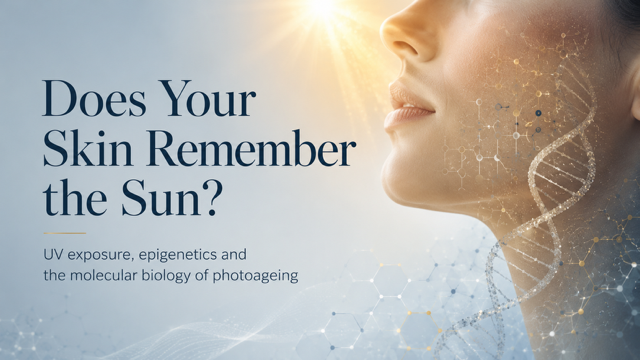
Most people understand that ultraviolet radiation can cause sunburn, pigmentation, premature skin ageing and skin cancer.
But a more interesting question is now emerging from molecular biology:
Can past sun exposure leave a lasting molecular imprint on the skin?
For many years, dermatology has focused on the visible and genetic consequences of UV exposure: redness, tanning, pigmentation, collagen breakdown, DNA damage and mutation. These remain central to our understanding of photoageing and skin cancer.
However, newer research suggests that UV radiation may also influence the epigenome; the regulatory layer that helps determine how genes are switched on, switched off, or made more or less accessible. Recent reviews have highlighted UV-induced effects on DNA methylation, histone modification and chromatin regulation as potentially important contributors to skin ageing and carcinogenesis (Barnes et al., 2024).
Your DNA is the code. Epigenetics helps decide how that code is read.
This matters because skin ageing is not simply a matter of collagen “wearing out”. The skin is a living, responsive organ. Its cells are constantly interpreting signals from the environment: ultraviolet radiation, pollution, inflammation, hormones, oxidative stress, nutrition, smoking and time itself.
Normal ageing and sun-induced ageing are not the same
There is an important distinction between intrinsic ageing and photoageing.Intrinsic ageing is the natural ageing process of skin. It is influenced by time, genetics, hormones, metabolism and gradual changes in cellular repair. Intrinsically aged skin tends to become thinner, drier, more fragile, less elastic and slower to heal. The wrinkles are often finer, and the skin may appear more delicate or translucent.
Photoageing is different; photoaged skin is skin that has been remodelled by repeated ultraviolet exposure. It tends to show coarser wrinkles, uneven pigmentation, solar lentigines, telangiectasia, rough texture, actinic change and loss of elasticity. Histologically, it is associated with solar elastosis, abnormal dermal matrix remodelling, chronic inflammatory signalling and accumulation of UV-induced DNA damage.
So sun-damaged skin is not simply “older skin”. Chronologically aged skin becomes biologically slower and thinner. UV-aged skin becomes biologically disrupted, inflamed and remodelled.
What happens at the level of methylation?
One of the most studied epigenetic mechanisms is DNA methylation. This involves adding methyl groups to DNA, often in regions that help regulate gene activity. Normal ageing and UV exposure can both alter DNA methylation, but they do not appear to do so in identical ways.
Human skin studies have shown that intrinsic ageing and chronic sun exposure are associated with distinct epigenetic changes in epidermis and dermis (Grönniger et al., 2010). Later whole-genome work also identified widespread genomic regions of altered methylation in older, sun-exposed skin (Vandiver et al., 2015).
With intrinsic ageing, the skin develops gradual epigenetic drift. Some methylation marks are gained, others are lost, and the regulatory system becomes less precise over time. This is one reason methylation patterns can be used to estimate biological age.
With chronic UV exposure, the pattern appears more environmentally driven. UV may contribute to broader disruption of methylation across parts of the genome, while also causing more localised methylation changes in specific regulatory regions.
In normal ageing, the skin’s genetic regulation gradually drifts. In photoageing, UV exposure appears to disturb that regulation more aggressively, loosening control across parts of the genome while also switching off selected protective pathways.
This matters because methylation changes can influence repair pathways, inflammation, matrix regulation and cancer-protective mechanisms. For example, if genes involved in restraining matrix degradation or supporting DNA repair are inappropriately regulated, the skin may become more vulnerable to photoageing and carcinogenesis.
UV does not only damage DNA
UV radiation can damage DNA directly, particularly through UVB-induced photolesions. If these lesions are not repaired before a cell divides, they can become fixed mutations.
UVA penetrates more deeply into the dermis and contributes strongly to oxidative stress, fibroblast dysfunction and matrix degradation.
But beyond these familiar mechanisms, UV can also affect the systems that control cell behaviour. These include DNA methylation, histone modification and chromatin organisation.
This gives us a broader model of sun damage; UV exposure does not only change the DNA code. It may also alter the regulatory machinery that determines how that code is read.
Can the skin repair these changes?
Some environmental effects on DNA and gene regulation can be repaired or reversed.
The skin has DNA repair systems that can remove many forms of UV-induced damage. Some epigenetic changes are also dynamic and may normalise after the environmental stress has passed.
This is important as it would be too simplistic to say that every individual sun exposure permanently changes the skin in the same way.
However, recovery is not limitless; repeated UV exposure can overwhelm repair systems, fix mutations into the DNA sequence, promote cellular senescence, alter immune signalling and leave longer-lasting changes in the regulatory systems that control skin-cell behaviour.
Some of the molecular effects of sun exposure can be repaired. But repeated UV exposure can leave changes that accumulate over time; not only in the DNA code itself, but also in the systems that control how that code is read.
Fibroblasts, senescence and collagen breakdown
The visible signs of photoageing are not simply caused by collagen disappearing.
Fibroblasts are the cells responsible for producing and maintaining collagen, elastin and other components of the extracellular matrix. With repeated UV exposure, fibroblasts may enter altered states, including senescence. Senescent cells no longer behave like healthy young fibroblasts. They may produce inflammatory signals and matrix-degrading enzymes that contribute to wrinkling, thinning and textural change.
This means UV can affect the skin in two linked ways; it can damage the matrix itself, and it can also change the behaviour of the cells responsible for maintaining that matrix.
That is why photoageing is better understood as biological remodelling, not simply “collagen loss”. Recent reviews of skin ageing and senescence increasingly emphasise this shift from structural damage alone to altered cellular state and tissue regulation (Dal Pozzo et al., 2024).
What stimulates or changes methylation?
Methylation is controlled by enzymes called DNA methyltransferases, including DNMT1, DNMT3A and DNMT3B. These enzymes add or maintain methyl marks on DNA.
Methylation also depends on cellular metabolism, including the availability of methyl donors from one-carbon metabolism. Nutrients such as folate, vitamin B12, choline, methionine and related pathways help support methyl-group availability, although this does not mean that taking supplements simply “improves” skin methylation. The methylome is highly regulated. Methylation changes are specific to tissue, cell type, age, disease state and environmental exposure.
In skin, methylation can be influenced by ageing, UV exposure, oxidative stress, inflammation, hormones, smoking, metabolism, cell turnover, DNA damage and DNA repair.
UV does not simply increase or decrease methylation uniformly. It may promote focal methylation changes in selected genes while also destabilising methylation maintenance more broadly through oxidative and DNA-damage stress.
What do twin studies tell us?
Twin studies are particularly helpful because identical twins share essentially the same inherited DNA. When identical twins age differently, this shows the importance of environment.
Genes influence skin type, pigmentation, tanning ability, collagen biology, repair capacity and baseline susceptibility to damage. But environmental factors strongly influence how the skin actually ages.
Sun exposure, smoking, pollution, occupation, weight change, hormones, nutrition and skin-protective behaviour can all produce visible differences between genetically identical individuals. Studies of identical twins have shown that lifestyle and environmental exposures, including smoking and sun exposure, can contribute to visible differences in facial ageing despite shared genetics (Guyuron et al., 2009).
Your genes influence how your skin starts life; your environment influences how your skin travels through life.
This is also relevant to epigenetics. Recent twin methylation work suggests that the skin methylome may be relatively less heritable than the blood methylome, supporting the idea that skin methylation is particularly responsive to environmental and non-genetic influences (Shore et al., 2024).
The skin may be one of the organs where the environment leaves a visible and measurable molecular trace.
Can food, vitamins or drugs help repair sun damage?
There is a crucial distinction between supporting repair and erasing damage.
No food, supplement or skincare product should be described as reversing fixed UV-induced DNA mutations. Once a mutation is established in the DNA sequence, it is generally not simply reversed by nutrition or topical treatment. However, some interventions may support repair pathways, reduce oxidative stress, reduce inflammation or improve the visible consequences of photoageing.
Nicotinamide, a form of vitamin B3, has clinical evidence for reducing actinic keratoses and non-melanoma skin cancers in high-risk individuals while treatment is continued. In the ONTRAC phase 3 trial, oral nicotinamide reduced new non-melanoma skin cancers and actinic keratoses in high-risk patients, but it should be viewed as an adjunct rather than a substitute for sun protection (Chen et al., 2015).
Topical retinoids, especially tretinoin, have some of the best evidence for improving visible photoageing. They can improve fine wrinkling, texture, pigmentation irregularity and collagen regulation over time. They do not remove fixed mutations, but they can improve aspects of the photoaged skin phenotype.
Antioxidant-rich diets may support normal repair biology. Vitamin C, polyphenols, adequate protein and healthy dietary patterns can contribute to resilience, collagen synthesis and oxidative-stress regulation.
Topical antioxidants, including vitamin C, vitamin E, ferulic acid, niacinamide and polyphenol-based formulations, may help reduce oxidative stress when used alongside sunscreen. Again, their role is supportive rather than curative.
What about vitamin D?
Vitamin D is sometimes described as an antioxidant, but in skin it is better understood as a hormone-like regulatory molecule.
Through vitamin D receptor signalling, vitamin D may support DNA repair, modulate oxidative stress, influence inflammation and help maintain normal keratinocyte differentiation and barrier function. Experimental work has suggested that active vitamin D and analogues can reduce some forms of UV-induced DNA damage, but this does not make vitamin D a substitute for photoprotection (Mason et al., 2010).
UVB helps generate vitamin D, but UVB also causes direct DNA damage. Vitamin D can be maintained through diet or supplementation where appropriate, while UV protection remains the primary strategy for preventing photoageing and skin cancer.
Can we measure sun damage in blood?
Oxidative stress and methylation can both be measured in blood, but interpretation is difficult. Reactive oxygen species are short-lived, so tests usually measure downstream oxidative-stress markers such as oxidised DNA products, lipid peroxidation markers, protein oxidation or antioxidant capacity. These can reflect systemic oxidative stress, but they do not specifically measure UV damage in the skin.
DNA methylation can also be measured in blood and is used in biological-age or epigenetic-clock research. However, blood methylation mainly reflects blood and immune-cell biology. It is not the same as the methylation state of sun-exposed facial skin.
Skin-specific methylation studies usually require skin sampling, such as biopsy, tape stripping or other tissue-based methods. There is no routine blood test that can accurately measure a person’s lifetime sun damage or the epigenetic “memory” of UV exposure in their skin.
Skin cancer: genetics and epigenetics together
UV-induced skin cancer is strongly linked to DNA damage and mutation. A tumour-suppressive pathway does not always need to be mutated to become less effective. In some contexts, it may be functionally silenced or dysregulated through epigenetic mechanisms.
This means the biological legacy of UV exposure may include direct DNA damage and mutation, oxidative stress, altered methylation, histone and chromatin changes, cellular senescence, chronic inflammatory signalling, impaired repair responses, and increased risk of photoageing and skin cancer.
These mechanisms do not replace each other. They interact.
Why prevention still matters most
The most important implication of this emerging science is not that everyone needs expensive “epigenetic” skincare. The more important message is simpler and more powerful:
UV protection is not just about avoiding sunburn. It is about reducing the cumulative biological stress that can reshape how skin cells behave over time.
This includes daily broad-spectrum sunscreen, protective clothing, shade, avoiding tanning, and recognising that UVA exposure can occur even when the skin does not burn. It also means understanding that visible ageing and skin cancer risk are influenced by a lifetime of exposures, not only by what happens on a single sunny day.
The skin is not a passive surface. It is a dynamic biological organ that responds, adapts, repairs and sometimes retains traces of what it has experienced.
So the question “Does your skin remember the sun?” is not just poetic. It reflects a serious and evolving area of dermatological science. The answer appears to be – in several important biological ways, it may.
Selected references
Barnes BM, Shyne A, Gunn DA, Griffiths CEM, Watson REB. Epigenetics and ultraviolet radiation: implications for skin ageing and carcinogenesis. Skin Health and Disease. 2024;4(6):e410.
Grönniger E, Weber B, Heil O, et al. Aging and chronic sun exposure cause distinct epigenetic changes in human skin. PLoS Genetics. 2010;6(5):e1000971.
Vandiver AR, Irizarry RA, Hansen KD, et al. Age and sun exposure-related widespread genomic blocks of hypomethylation in nonmalignant skin. Genome Biology. 2015;16:80.
Dal Pozzo L, Cavallini C, et al. Role of epigenetics in the regulation of skin aging and cellular senescence. Biomedicine & Pharmacotherapy. 2024.
Shore CJ, et al. Genetic effects on the skin methylome in healthy older twins. American Journal of Human Genetics. 2024.
Guyuron B, Rowe DJ, Weinfeld AB, et al. Factors contributing to the facial aging of identical twins. Plastic and Reconstructive Surgery. 2009;123(4):1321–1331.
Chen AC, Martin AJ, Choy B, et al. A phase 3 randomized trial of nicotinamide for skin-cancer chemoprevention. New England Journal of Medicine. 2015;373:1618–1626.
Mason RS, Sequeira VB, Dixon KM, et al. Photoprotection by 1α,25-dihydroxyvitamin D and analogs. Journal of Steroid Biochemistry and Molecular Biology. 2010;121(1–2):164–168.
Dr Iaisha Ali, MB ChB MRCP MSc(Oxon)
A London-based dermatologist, specialises in acne, hair loss, hormonal skin disorders, and skin cancer treatment.
Dr Ali has been practising dermatology since 2002, with over 25 years of medical experience delivering consultant-led dermatological care. She previously served as Consultant Dermatologist and Clinical Head of Dermatology at Imperial College Healthcare NHS Trust, where she led complex dermatology services and specialist referral clinics.
