
How formulation choice, progestogen androgenicity and oestrogen route affect acne, hair loss, hirsutism and seborrhoea
Clinical Note
Direct comparative outcome studies on skin and hair effects between HRT regimens remain limited, and many recommendations are extrapolated from endocrine and pharmacological data combined with clinical experience. Individual prescribing decisions should be made with a qualified clinician.
Types of HRT Formulations
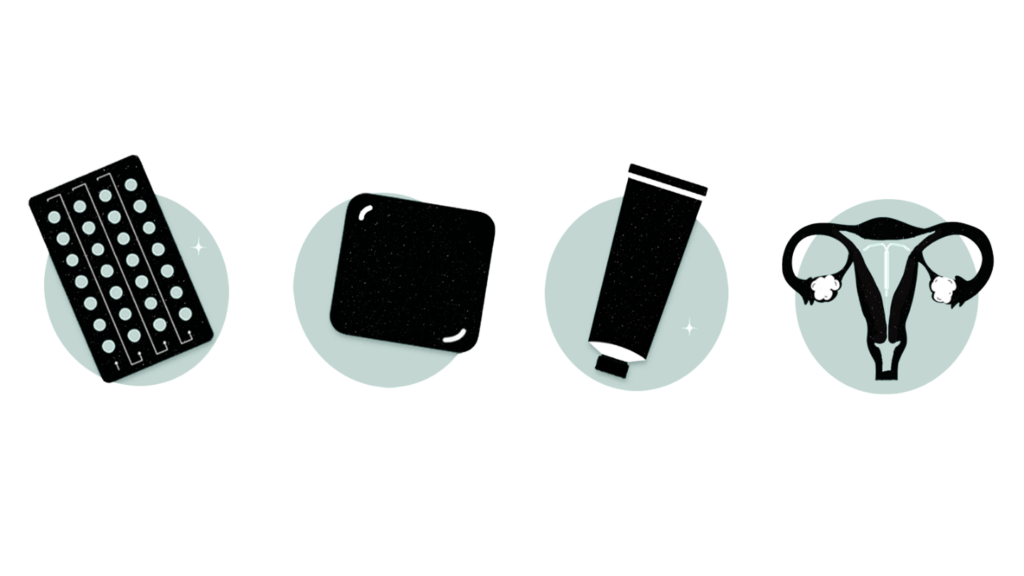
Hormone replacement therapy is delivered through a variety of formulations and routes. The choice between them affects not just efficacy but also the metabolic and hepatic profiles — and, critically for many patients, the impact on skin and hair.
Oral Tablets
Hepatic first-pass metabolism
| Common UK Preparations & Skin/Hair Relevance | Prescribing Considerations |
|---|---|
| • Estradiol valerate / hemihydrate | • Raises SHBG, clotting factors and triglycerides via liver |
| • Conjugated equine oestrogens (CEE) | • Greater VTE risk than transdermal preparations |
| • Tibolone (synthetic; weak oestrogenic, androgenic and progestogenic activity) | • Avoid in active liver disease or significant VTE risk |
| • Micronised progesterone (Utrogestan – oral or vaginal use) | • Relative caution in migraine with aura |
| • Femoston (estradiol + dydrogesterone), Kliofem/Kliovance (estradiol + norethisterone), Prempak-C (CEE + MPA) | • More pronounced hepatic metabolic effects than transdermal therapy at equivalent oestradiol levels |
| • Best route for raising SHBG and lowering free testosterone | |
| • Most useful for acne, hirsutism and androgenetic alopecia | |
| • Greater fluctuation in hormone levels compared with transdermal therapy |
Transdermal Patches
Bypasses hepatic first-pass metabolism
| Common UK Preparations & Practical Points | Prescribing Considerations & Skin/Hair Relevance |
|---|---|
| • Estradot, Evorel, FemSeven (oestrogen-only) | • Lower VTE and stroke risk than oral therapy |
| • Evorel Conti / Evorel Sequi (combined with norethisterone) | • Preferred where thrombotic risk is a concern |
| • Apply below the waistline and rotate application sites | • Preferred in obesity, diabetes, hypertension and prior VTE |
| • Heat increases absorption (baths, saunas) | • Often preferred in women with migraine, including migraine with aura |
| • Matrix patches are generally better tolerated than reservoir systems | • Minimal SHBG induction and therefore less anti-androgenic systemically |
| • Can cause local irritant or allergic contact dermatitis | • Less useful for androgen-mediated conditions unless combined with anti-androgenic strategies |
| • Evorel Conti contains norethisterone, creating an additional androgenic consideration |
Gels & Sprays
Transdermal delivery with flexible dosing
| Common UK Formulations & Advantages | Practical & Skin/Hair Points |
|---|---|
| • Oestrogel (estradiol gel) | • Avoid washing the application site for at least one hour |
| • Sandrena (unit-dose gel sachets) | • Risk of secondary transfer to partners or children before the gel dries |
| • Lenzetto (transdermal spray) | • Advise covering the site once dry |
| • Flexible dose titration | • Minimal SHBG induction, similar to patches |
| • Stable serum estradiol levels | • Less useful for androgen-mediated conditions unless combined with an anti-androgenic progestogen or adjunctive treatment such as spironolactone |
| • Useful in migraine sufferers | |
| • Same low VTE profile as patches |
Subcutaneous Implants
Specialist use with steady-state hormone levels
| Overview | Cautions |
|---|---|
| • Estradiol pellets inserted subcutaneously every 4–8 months | • Difficult to reverse once inserted |
| • Relatively uncommon in routine UK NHS practice | • Risk of supraphysiological oestradiol levels |
| • Mainly used in specialist menopause clinics and private practice | • Monitoring of serum oestradiol may be required |
| • Useful in women with poor absorption or refractory severe symptoms | • No first-pass effect, therefore SHBG effects are less pronounced than with oral therapy |
Vaginal / Local Oestrogen
Minimal systemic absorption
| Common UK Preparations | Prescribing Considerations |
|---|---|
| • Vagifem / Vagirux (estradiol pessaries) | • Minimal systemic absorption at standard doses |
| • Ovestin (estriol cream) | • Generally does not require additional progestogen |
| • Imvaggis (estriol pessaries) | • Used for vaginal dryness, dyspareunia, recurrent UTIs and urogenital atrophy |
| • Estring (estradiol vaginal ring) | • Systemic skin and hair effects are generally negligible |
| • Can cause a small transient rise in serum estradiol initially |
Injectable Oestrogen
Not standard UK menopausal practice
Injectable estradiol preparations (for example estradiol valerate and estradiol cypionate) are used infrequently in UK menopausal practice and are encountered more commonly in specialist endocrine and gender medicine settings.
Their inclusion here is for completeness and should not be interpreted as a recommendation for routine menopausal management.
Key Points
- Bypasses first-pass metabolism
- Does not produce the hepatic SHBG-raising effect seen with oral therapy
- Variable absorption and hormone-level fluctuation between doses
- Typically administered monthly or fortnightly
Intrauterine Progestogen System (IUS)
Endometrial protection with low systemic exposure
| Key Preparation & Clinical Role in HRT | Androgenic Considerations |
|---|---|
| • Mirena IUS (levonorgestrel 52 mg; releases approximately 20 micrograms/day locally) | • Systemic levonorgestrel exposure is substantially lower than oral progestogen regimens |
| • Provides endometrial protection alongside systemic oestrogen | • Practical option for women with androgen-sensitive conditions who cannot tolerate oral progestogens |
| • Allows independent selection of the oestrogen route | • Acne, seborrhoea and hair shedding may still occur in susceptible women |
| • Frequently used when oral progestogens are poorly tolerated | • Not equivalent to androgenically neutral progestogens such as micronised progesterone or dydrogesterone |
| • Off-label use as the progestogen component of HRT is well established in UK practice |
Androgenic Activity of Progestogens
Progestogens vary in their androgenic potency, which is clinically relevant for patients dealing with PCOS-related hormonal skin issues, hirsutism, and oily scalp problems.
However, the degree of androgenicity is frequently overstated in patient-facing resources and even in some clinical guidance. The reality is considerably more nuanced than a simple ranking system, and dosage is critically important.
Androgenicity may arise through:
- Direct binding to the androgen receptor (AR)
- Peripheral conversion to active androgens
- Suppression of sex hormone-binding globulin (SHBG)
These mechanisms do not always occur together.
Norethisterone (NET)
Norethisterone illustrates this complexity well.
It is structurally derived from nortestosterone and possesses measurable androgenic activity, although substantially weaker than testosterone. At the doses used in standard HRT (0.5–1 mg daily), the most clinically relevant effect is suppression of SHBG, which increases free testosterone levels.
Clinically significant sebaceous stimulation and overt androgenic side effects have mainly been demonstrated at substantially higher doses than those used in HRT.
Norethisterone also partially aromatises to ethinylestradiol, providing a counterbalancing oestrogenic effect. For this reason, describing norethisterone as a highly androgenic progestogen at standard HRT doses is often inaccurate.
Levonorgestrel, by contrast, has substantially higher androgen receptor binding affinity and stronger SHBG suppression, making it one of the more androgenic progestogens used in HRT.
Androgenic Activity of Progestogens
Progestogens vary in their androgenic potency, and this is clinically relevant for patients with acne, hirsutism, hair loss, or seborrhoea. However, the degree of androgenicity is frequently overstated in patient-facing resources and some clinical guides. The picture is more nuanced than a simple ranking suggests, and the dose used matters considerably.
Androgenicity arises through several mechanisms: direct binding to the androgen receptor (AR), conversion to active androgens peripherally, and suppression of sex hormone-binding globulin (SHBG) — a protein that keeps circulating androgens biologically inactive. These mechanisms do not always move in parallel.
Norethisterone (NET) illustrates this complexity well. It is structurally derived from nortestosterone and has measurable androgenic activity, substantially weaker than testosterone, though precise estimates vary depending on the assay system used. Its androgenic effects are strongly dose-dependent: clinically significant sebaceous stimulation has mainly been demonstrated at substantially higher doses than those used in HRT, and frank androgenic side effects such as acne or voice changes have mainly been reported at substantially higher doses (e.g. 10–40 mg/day), an order of magnitude above the 0.5–1 mg/day used in standard HRT. At HRT doses, the primary clinically relevant effect is dose-dependent suppression of SHBG, which raises free testosterone, rather than direct androgenic tissue stimulation.
Norethisterone also partially aromatises to ethinylestradiol, contributing a counterbalancing oestrogenic component, and its metabolism is pharmacologically complex with some metabolites potentially having differing receptor effects. The characterisation of norethisterone as a highly androgenic progestogen derives largely from older pharmacological literature at doses not representative of HRT practice; at standard HRT doses, low to moderate androgenic activity is a more accurate description. Levonorgestrel, by contrast, has substantially higher AR binding affinity and more potent SHBG suppression than NET, and is among the more androgenic progestogens used in HRT.
The table below summarises the relative androgenic activity of commonly used progestogens in HRT.
| Progestogen | Generation / Class | Activity at HRT Doses | Notes |
|---|---|---|---|
| Micronised Progesterone (Utrogestan – oral or vaginal) | Natural / Bioidentical | Negligible | Binds androgen receptors only weakly. Metabolised to allopregnanolone. Often preferred for patients sensitive to skin and hair changes. |
| Dydrogesterone (Femoston) | Retroprogesterone | Negligible | Highly selective. No significant androgenic, oestrogenic or glucocorticoid activity. |
| Norethisterone (NET) | Second-generation 19-nortestosterone derivative | Low to Moderate | Suppresses SHBG and may increase free testosterone. Less favourable than androgen-neutral options but not strongly androgenic at standard HRT doses. |
| Levonorgestrel (Evorel Conti, Mirena IUS) | Second-generation 19-nortestosterone derivative | High | One of the more androgenic progestogens used in HRT. Stronger androgen receptor binding and SHBG suppression than norethisterone. |
| Medroxyprogesterone Acetate (MPA) | 17α-Hydroxyprogesterone derivative | Moderate | Some androgen receptor binding and moderate SHBG suppression. Less commonly used in modern UK HRT practice. |
| Cyproterone Acetate (CPA) | Anti-androgenic progestogen | Anti-androgenic | Potent androgen receptor blocker. Can improve acne, hirsutism and androgen-driven hair loss. Generally used in specialist settings. |
| Drospirenone | Spironolactone-derived progestogen | Anti-androgenic | May improve acne and seborrhoea. Possesses mild anti-mineralocorticoid activity. |
| Nomegestrol Acetate | 19-Norprogesterone derivative | Minimal to Neutral | Limited HRT use but generally regarded as having a favourable androgenic profile. |
| Clinical takeaway: For patients with androgen-sensitive skin or scalp conditions, micronised progesterone (Utrogestan) and dydrogesterone are the most favourable progestogens. Norethisterone at HRT doses is less favourable primarily because it suppresses SHBG, but it is not the potent androgen it is sometimes described as. Levonorgestrel in systemic doses (Evorel Conti) is among the more androgenic options and the greater practical concern. The Mirena IUS offers a pragmatic middle ground with lower systemic LNG exposure, though it is not equivalent to androgenically neutral progestogens. |
Oral vs Transdermal Oestrogen: the Hair and Scalp Difference
The route of oestrogen delivery profoundly alters its systemic effects — particularly on SHBG — and this is one of the most clinically underappreciated distinctions in HRT prescribing.
ORAL OESTROGEN AND SHBG
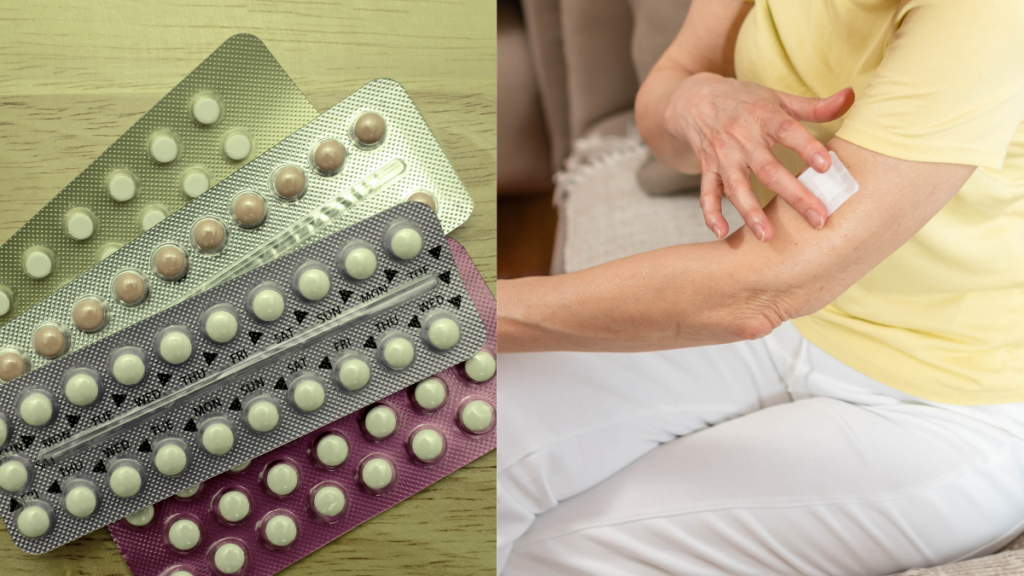
When oestrogen is taken orally, it passes through the liver before entering systemic circulation — the hepatic first-pass effect. The liver responds to this supraphysiological oestrogen exposure by upregulating SHBG production. Higher SHBG means more testosterone is bound and biologically inactive, leaving less free androgen available to act on hair follicles, sebaceous glands, and skin.
Published data suggest oral oestrogen can produce substantial SHBG increases, though the magnitude varies considerably depending on dose, formulation (oral oestradiol vs CEE), age, and baseline androgen status. This effect is not seen with transdermal delivery, which is the basis for the anti-androgenic advantage of the oral route in skin and hair conditions.
TRANSDERMAL OESTROGEN AND SHBG
Transdermal oestrogen — patches, gels, sprays — bypasses the liver and delivers oestradiol directly into systemic circulation without hepatic stimulation. SHBG rises little or not at all. Transdermal oestrogen generally has less impact on SHBG and free androgen levels than oral oestrogen, and may therefore provide less anti-androgenic benefit in androgen-sensitive conditions. This is a comparative observation: transdermal oestrogen does not worsen these conditions, but it does not replicate the SHBG-raising advantage of the oral route.
| GREATER ANTI-ANDROGENIC EFFECT Oral oestradiol Substantially raises SHBG → lowers free testosterone → reduced androgenic drive to follicles and sebaceous glands. Most useful for acne, androgenetic alopecia, and hirsutism in the perimenopause. Higher VTE risk than transdermal. | LESSER ANTI-ANDROGENIC EFFECT Transdermal oestradiol Minimal SHBG induction; less impact on free androgen levels. Preferred where VTE, cardiovascular, or metabolic risk is a concern. Less useful for androgen-mediated skin/hair conditions unless combined with anti-androgenic strategies. |
| Balancing risks: Oral oestrogen’s SHBG benefit must be weighed against its higher VTE risk (approximately 2–4× vs baseline; transdermal oestrogen is associated with substantially lower or minimal excess VTE risk compared with oral therapy). For women at higher thrombotic risk, adding a low-dose oral anti-androgen (e.g. spironolactone) alongside transdermal HRT may be a preferable strategy. |
Which HRT is Best for Androgen-Sensitive Conditions?
The optimal approach typically combines the most favourable oestrogen route with the least androgenic progestogen. Even if norethisterone must be used for endometrial protection, its SHBG-suppressing effect is partially offset when paired with oral oestradiol, which simultaneously raises SHBG.
ACNE
Acne in perimenopause or menopause is frequently driven by the relative rise in free androgens as oestrogen wanes. The sebaceous gland is exquisitely sensitive to androgens, particularly DHT.
| PREFERRED | LESS FAVOURABLE |
|---|---|
| 1. Oral oestradiol (↑ SHBG, ↓ free testosterone) 2. Micronised progesterone or dydrogesterone 3. Drospirenone-containing formulations (e.g. Angeliq) 4. Cyproterone acetate if still cycling (note meningioma caution) | 1. Levonorgestrel systemic (most androgenic, potent SHBG suppression) 2. MPA (moderate androgenicity) 3. Norethisterone: less favourable via SHBG suppression; prefer neutral alternatives where available |
ANDROGENETIC HAIR LOSS (AGA)
Female AGA is driven by DHT miniaturising follicles in genetically predisposed women. Menopausal oestrogen loss accelerates this. HRT’s role is to reduce free androgen exposure and support the follicular growth cycle.
| PREFERRED | LESS FAVOURABLE |
|---|---|
| 1. Oral oestradiol (greater SHBG-raising effect) 2. Micronised progesterone or dydrogesterone 3. Mirena IUS if oral progestogen not tolerated (note: not equivalent to neutral progestogens) 4. Consider spironolactone or finasteride as adjuncts (under specialist supervision) | 1. Levonorgestrel in combined patches (Evorel Conti) — greater androgenic concern 2. MPA 3. Norethisterone: avoid if better alternatives available |
HIRSUTISM
Excess facial or body hair growth driven by elevated free androgens, commonly reflecting relative hyperandrogenaemia as oestrogen declines at the menopause.
| PREFERRED | LESS FAVOURABLE |
|---|---|
| 1. Oral oestradiol (greatest SHBG-raising effect) 2. Micronised progesterone or dydrogesterone 3. CPA or spironolactone as adjunct (note CPA meningioma caution) 4. Eflornithine cream topically for facial hairLaser hair reduction / intense pulsed light (IPL) for established facial/body hair | 1. Levonorgestrel (systemic) 2. MPA 3. Norethisterone: less favourable via SHBG suppression; less harmful at HRT doses than often stated |
SEBORRHOEA (OILY SKIN/SCALP)
Sebum production is androgen-driven via sebaceous gland 5α-reductase activity. Perimenopausal seborrhoea often coexists with acne and scalp seborrhoeic dermatitis.
| PREFERRED | LESS FAVOURABLE |
|---|---|
| 1. Oral oestradiol (↑ SHBG → ↓ free testosterone → ↓ sebum) 2. Micronised progesterone 3. Dydrogesterone 4. Drospirenone-containing formulations | 1. Levonorgestrel (systemic) 2. MPA 3. Norethisterone: direct sebaceous stimulation not well established at HRT doses, but SHBG suppression is unfavourable |
Summary Reference
| CONDITION | BEST OESTROGEN ROUTE | BEST PROGESTOGEN | LESS FAVOURABLE PROGESTOGENS |
|---|---|---|---|
| Acne | Oral (↑ SHBG) | Micronised P4, dydrogesterone, drospirenone | LNG (systemic), MPA; NET less ideal but low–moderate risk at HRT doses |
| Hair loss (AGA) | Oral (↑ SHBG) | Micronised P4, dydrogesterone, Mirena IUS* | LNG in patches (Evorel Conti), MPA; NET avoid if alternatives available |
| Hirsutism | Oral (↑ SHBG most) | Micronised P4, dydrogesterone ± CPA/spironolactone | LNG (systemic), MPA; NET less favourable but not potently androgenic at HRT doses |
| Seborrhoea | Oral (↑ SHBG) | Micronised P4, dydrogesterone, drospirenone | LNG (systemic), MPA; NET — SHBG suppression unfavourable; direct sebaceous effect not established at HRT doses |
* Mirena IUS provides lower systemic LNG than oral/patch LNG but is not equivalent to androgenically neutral progestogens; androgenic effects can still occur in susceptible women.
References
[1] Stanczyk FZ, Hapgood JP, Winer S, Mishell DR Jr. Progestogens used in postmenopausal hormone therapy: differences in their pharmacological properties, intracellular actions, and clinical effects. Endocr Rev. 2013;34(2):171-208. PMID: 23238854
[2] Africander D, Verhoog N, Hapgood JP. Comparing the androgenic and estrogenic properties of progestins used in contraception and hormone therapy. PLoS One. 2017;12(8):e0183591. PMID: 28711501
[3] Kloosterboer HJ, Vonk-Noordegraaf CA, Turpijn EW. Selectivity in progesterone and androgen receptor binding of progestagens used in oral contraceptives. Contraception. 1988;38(3):325-32. PMID: 2851054
[4] Kuhl H. Clinical significance of the androgenicity of progestins in hormonal therapy in women. Gynecol Endocrinol. 1990;4(3):223-38. PMID: 2268868
[5] Carlstrom K, Karlsson R, von Schoultz B. Binding of levonorgestrel, norethisterone and desogestrel to human sex hormone binding globulin and influence on free testosterone levels. Gynecol Obstet Invest. 1989;28(3):154-7. PMID: 2525511
[6] Cullberg G, Samsioe G, Astedt B. Effects of different doses of norethisterone on ovarian function, serum sex hormone binding globulin and high density lipoprotein-cholesterol. Acta Obstet Gynecol Scand Suppl. 1993;152:43-51. PMID: 8334889
[7] Burton JL, Cartlidge M, Shuster S. Effect of synthetic progesterone on sebum excretion rate. BMJ. 1973;2:370-2. PMID: 4703469
[8] Punnonen R, Rauramo L. Twenty-two weeks of transdermal estradiol increases sex hormone-binding globulin in surgical menopausal women. Maturitas. 1997;26(3):195-8. PMID: 9228496
[9] Powers MS, Schenkel L, Darley PE, Good WR, Balestra JC, Place VA. Pharmacokinetics and pharmacodynamics of transdermal dosage forms of 17B-estradiol: comparison with conventional oral estrogens. Am J Obstet Gynecol. 1985;152(8):1099-106. PMID: 2512035
[10] Scarabin PY, Oger E, Plu-Bureau G. Differential association of oral and transdermal oestrogen-replacement therapy with venous thromboembolism risk. Lancet. 2003;362(9382):428-32. PMID: 12927438
[11] Mohammed K, Abu Dabrh AM, Benkhadra K, et al. Oral vs transdermal estrogen therapy and vascular events: a systematic review and meta-analysis. J Clin Endocrinol Metab. 2015;100(11):4012-20. PMID: 26544651
[12] Renoux C, Dell Aniello S, Garbe E, Suissa S. Transdermal and oral hormone replacement therapy and the risk of stroke: a nested case-control study. BMJ. 2010;340:c2519. PMID: 20483889
[13] Canonico M, Fournier A, Camus E, et al. Progestogens and venous thromboembolism among postmenopausal women taking hormone therapy. Maturitas. 2010;66(3):292-6. PMID: 21489728
[14] Vinogradova Y, Coupland C, Hippisley-Cox J. Use of hormone replacement therapy and risk of venous thromboembolism: nested case-control studies using the QResearch and CPRD databases. BMJ. 2019;364:k4810. PMID: 30626572
[15] Gompel A, Plu-Bureau G. Progesterone, progestins and the endometrium in perimenopause and in menopausal hormone therapy. Climacteric. 2018;21(4):321-5. PMID: 29860893
[16] Palacios S, Mejia A, Neyro JL. Treatment of the genitourinary syndrome of menopause. Climacteric. 2015;18(Suppl 1):23-9. PMID: 26366799
| Abbreviations: NET = norethisterone; LNG = levonorgestrel; MPA = medroxyprogesterone acetate; CPA = cyproterone acetate; P4 = progesterone; SHBG = sex hormone-binding globulin; AGA = androgenetic alopecia; AR = androgen receptor; DHT = dihydrotestosterone; VTE = venous thromboembolism; IUS = intrauterine system. This article is for informational purposes and does not replace individual clinical assessment. Many recommendations are extrapolated from pharmacological and endocrine data rather than direct comparative clinical trials. Prescribing decisions should be made with a qualified clinician. |
Dr Iaisha Ali, MB ChB MRCP MSc(Oxon)
A London-based dermatologist, specialises in acne, hair loss, hormonal skin disorders, and skin cancer treatment.
Dr Ali has been practising dermatology since 2002, with over 25 years of medical experience delivering consultant-led dermatological care. She previously served as Consultant Dermatologist and Clinical Head of Dermatology at Imperial College Healthcare NHS Trust, where she led complex dermatology services and specialist referral clinics.
