

The relationship between exercise and skin health has attracted increasing attention over the past decade. Traditionally, dermatology has focused on topical therapies, photoprotection and procedural interventions to maintain healthy skin. More recently, however, exercise has emerged as a potential systemic intervention capable of influencing skin ageing through improvements in circulation, inflammation, metabolism and extracellular matrix remodelling.
The current evidence suggests that regular physical activity may improve skin quality and resilience, although there remains limited direct evidence demonstrating reductions in facial wrinkles or increases in dermal collagen content in humans.
Exercise improves skin physiology
The 2024 narrative review by Oizumi et al. provides an overview of the biological mechanisms linking exercise and skin function. The authors describe exercise as producing widespread physiological changes that benefit the skin, including increased cutaneous blood flow, improved thermoregulation, enhanced mitochondrial function and better skin hydration.
Exercise increases blood flow to the skin during activity, improving oxygen and nutrient delivery to epidermal keratinocytes and dermal fibroblasts. Improved microcirculation also facilitates removal of metabolic waste products and supports normal tissue repair. These adaptations may contribute to healthier skin appearance and function over time.
The review also highlights that habitual exercise improves skin barrier function and stratum corneum hydration while reducing chronic low-grade inflammation, an important contributor to intrinsic skin ageing.
The muscle–skin axis
One of the most important concepts emerging from recent research is the “muscle–skin axis.”
During exercise, contracting skeletal muscle releases signalling proteins known as myokines, including IL-15, irisin and other exercise-induced mediators. These circulating factors appear capable of influencing distant tissues, including the skin.
Rather than acting solely through improved circulation, exercise may therefore alter dermal biology through endocrine signalling between skeletal muscle and dermal fibroblasts. This represents a significant shift in understanding how lifestyle interventions may influence skin ageing.
Effects on collagen and the extracellular matrix
The strongest experimental evidence comes from Nishikori and colleagues (2023), who investigated 16 weeks of supervised aerobic or resistance training in sedentary middle-aged women.
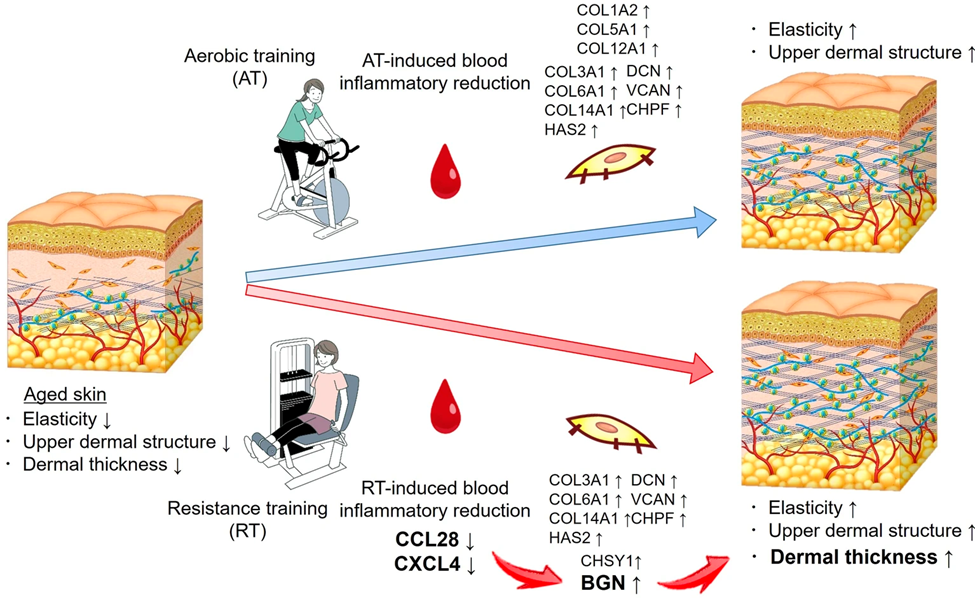
Both exercise programmes improved skin elasticity and upper dermal structure. However, resistance training produced an additional increase in dermal thickness.
Mechanistic experiments demonstrated changes in circulating factors that enhanced extracellular matrix-related gene expression in cultured human dermal fibroblasts. The investigators also identified increased expression of biglycan, a proteoglycan involved in collagen fibril organisation and dermal architecture.
Importantly, collagen itself was not directly measured. Consequently, the study supports the concept that exercise enhances extracellular matrix remodelling and creates a more favourable environment for collagen maintenance, rather than proving that exercise directly increases dermal collagen. This distinction is clinically important and avoids overstating the evidence.
Exercise and skin ageing
The 2025 review by Li et al. integrates current evidence and proposes several complementary mechanisms through which regular physical activity may slow aspects of skin ageing.
These include:
- improved dermal blood flow
- enhanced mitochondrial function
- reduced oxidative stress
- improved insulin sensitivity
- reduced chronic inflammation
- enhanced extracellular matrix remodelling
- improved sleep quality and hormonal regulation
Collectively these mechanisms support healthier skin function and may delay age-related deterioration of the dermis.
However, the authors emphasise that evidence directly demonstrating wrinkle reduction remains limited. Most available studies measure physiological markers such as elasticity, hydration, dermal thickness or barrier function rather than validated wrinkle scores.
Exercise and wrinkles
Despite widespread public belief that exercise reduces wrinkles, there are currently no large randomised controlled trials demonstrating clinically significant wrinkle reduction attributable solely to exercise.
Instead, exercise appears to improve the biological environment within which collagen maintenance and tissue repair occur.
Therefore, exercise should be viewed as supporting healthy skin ageing rather than replacing established interventions such as photoprotection, topical retinoids or evidence-based procedural treatments.
The importance of exercise intensity
The literature consistently suggests a dose-dependent relationship.
Moderate, regular exercise appears beneficial.
In contrast, prolonged, intense endurance exercise without adequate recovery may increase oxidative stress, ultraviolet exposure, dehydration and barrier disruption. Outdoor athletes therefore experience competing influences on skin ageing: favourable systemic effects from exercise balanced against accelerated photoageing from cumulative UV exposure.
This distinction is particularly relevant for footballers, runners and cyclists.
Clinical implications
Current evidence suggests that physically active individuals may demonstrate:
- improved skin elasticity
- greater dermal thickness
- healthier extracellular matrix remodelling
- improved barrier function
- increased skin hydration
- improved wound healing
- reduced chronic inflammation
However, these benefits are contingent upon appropriate sun protection, skin hygiene and recovery. Sweat, friction, ultraviolet radiation and environmental exposure remain significant contributors to premature skin ageing in athletes.
Conclusion
The emerging evidence supports regular physical activity as an important component of healthy skin ageing. Exercise appears to improve skin through multiple interconnected mechanisms involving circulation, mitochondrial health, inflammatory regulation and extracellular matrix remodelling.
The strongest evidence currently supports improvements in skin elasticity, dermal thickness and skin physiology rather than direct reductions in facial wrinkles.
Future research should focus on larger randomised trials using validated measures of wrinkle severity, collagen content and long-term clinical outcomes. Until then, exercise should be regarded as a valuable adjunct to—not a replacement for—established dermatological strategies such as sun protection, topical retinoids and evidence-based procedural treatments.
